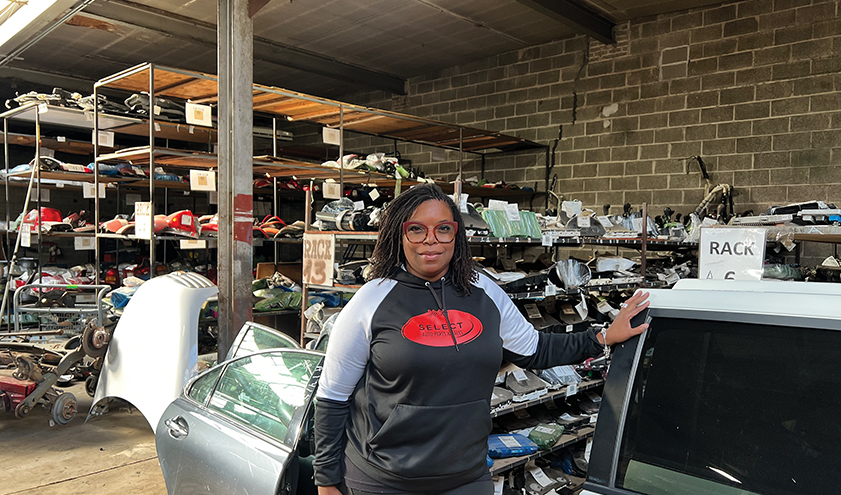
Breaking the mold of conventional auto recycling, Natasha Broxton, Founder & CEO, Select Auto Parts & Sales, and the Founder of Alitura Group, is rocking her business with a bold technology-first mindset.

By Caryn Smith with Natasha Broxton
Select Auto Parts & Sales is a Milwaukee-based automotive recycling company providing affordable, high-quality used auto parts, junk car buying, towing, and sustainable recycling services.
As Milwaukee’s only indoor auto recycler and a licensed salvage dealer through the State of Wisconsin, the company is known for well-preserved parts, reliable service, and operational integrity. Select serves repair shops, body shops, mechanics, and DIY vehicle owners who need dependable parts and practical solutions without dealership pricing.
Beyond parts and recycling, the company is committed to community impact through workforce development, environmental responsibility, and local partnerships.
If you have social media, you no doubt have seen Select’s founder Natasha Broxton rocking stages and conference networks beyond this industry to talk AI and technology’s impact on today’s businesses. As the owner of Milwaukee, Wisconsin’s only indoor auto recycling facility, Automotive Recycling caught up with the innovator to talk shop and tech.
Automotive Recycling: Tell us about your background.
Natasha Broxton: I spent almost ten years working in the AT&T business office before leaving to stay home with my kids. That transition led to helping my husband, Eric Broxton, who has been in tire recycling for over thirty years, with the bookkeeping, accounting, and administration on the business side.
That was my real introduction to the recycling industry. Not from the yard side. From the numbers side. And that foundation turned out to be exactly what I needed when the opportunity with Select Auto Parts came along.
AR: What led you to start an auto recycling business?
Broxton: A building owner contacted us because a 125,000-square-foot facility was filled with scrap tires and needed to be cleared out. Most people would have seen a cleanup job. We saw an opportunity.
After clearing the building, we made an offer on it.
Once we had it, Eric made a simple observation:
Milwaukee was not allowing any more outdoor facilities. When he has an idea, that usually means I have to execute. That was my green light. And that was over fourteen years ago. I have been here ever since.
AR: Share your facility’s story.
Broxton: We saw a problem and turned it into a solution. A 125,000-square-foot building that had been filled with junk tires became Milwaukee’s only indoor auto parts recycler. That transformation did not happen because we had a road map. It happened because we recognized what the market was missing and committed to building it.
There was no indoor facility serving this market. There were very few recyclers on the north side of Milwaukee. Customers wanted parts that were already inventoried, already on the shelf, already ready to go. We built the operation around that need.
I came into this industry with business experience but no automotive background. No experience in recycling, in dismantling, in parts grading, or in anything this industry runs on. Just the grit and the grind to figure it out.
AR: As “Milwaukee's Only Indoor Auto Parts Facility,” why was it important to build your facility this way?
Broxton: Three reasons.
There was no indoor facility in this market. There were not enough recyclers serving the north side of Milwaukee. And the demand for an accessible, organized parts experience was real and going unmet.
The indoor model also allowed us to maintain consistent standards year-round.
Cleanliness, organization, and professionalism are not accidents. They are systems. The facility gave us the infrastructure to build those systems the right way from the beginning.
AR: What roles do family members play in the business?
Broxton: My daughter, Nakayla Myrick-Broxton, is part of our sales operations and represents the next generation of leadership at Select Auto Parts. Watching her grow inside this business is one of the things I am most proud of. She is not just learning the industry. She is learning how to build and run something.
Eric owns All Scrap Metal Recycling and operates Tires Express, a tire recycling business. We are a family of operators. We understand each other’s businesses well, which keeps us aligned. There is something powerful about building alongside someone who is in it the same way you are.
AR: What surprised you along the way? What did you learn that could help others?
Broxton: For years, I walked this business alone.
I was raised to be quiet. Not to speak too loudly about what I was doing because it could be seen as bragging.
So I kept my head down, figured things out on my own, and did not ask for much help. I built Select Auto Parts without outside funding. Self-funded, fourteen years in, one of the only Woman-owned and Black-owned automotive recycling operations in the country, navigating an industry I had no prior experience in.
Everything changed when I started talking. Not just about the wins. About the struggles, too. When I became willing to share what I was actually going through, the doors started opening. People were genuinely amazed by this operation. For many of them, it was their first look at what automotive recycling actually is. That visibility led to Goldman Sachs 10KSB, the U.S. Chamber CO-100, national media features, and speaking opportunities I never would have found staying quiet.
The lesson is simple. Talk about your business. Both the good and the hard. The right people are listening.
AR: What challenges and opportunities shaped you?
Broxton: Being a self-funded continuously operated facility is not something I take for granted. Every resource had to be earned or figured out. That built a kind of discipline you cannot shortcut.
The opportunities that shaped this business came from the community. Partnerships with the local community college bring students through for industry exposure. Work with the Department of Workforce Development. Creating space for workers with disabilities. Business development programs where I found mentors who were patient and generous with what they knew. And surrounding myself with team members who are excellent at what they do.
Being willing to be in the community and live out loud about this business has opened doors that I did not even know existed. When outsiders got a look at what we built, it changed the conversation. That visibility is what created most of the opportunities I am grateful for today.
AR: Describe the Milwaukee marketplace and your primary customer base.
Broxton: Milwaukee is a working city. Our customer base reflects that. We serve collision repairers, mechanical shops, independent technicians, and retail customers who need quality parts at prices that make sense. The mix leans toward professional buyers, but our facility and the experience we deliver bring in retail customers who might not have considered a recycling yard before.
We also serve customers nationally. Our eBay presence has expanded our reach well beyond Milwaukee, which has been a meaningful revenue channel and a good way to move inventory efficiently.
AR: Certifications seem important to you. Share what certifications you have and why.
Broxton: Certifications matter because they signal standards. In an industry where quality and trust are everything, certifications give customers and partners a reason to choose you before they have direct experience with you.
Select Auto Parts & Sales holds WBENC certification as a Women’s Business Enterprise, along with WBE, SBE, and DBE certifications. These open procurement opportunities with corporate and government buyers who have supplier diversity requirements reflect a commitment to operating at a documented standard.
On the personal and professional side, I am a Certified AI Consultant, a Goldman Sachs 10KSB Scholar, and a U.S. Chamber CO-100 Honoree. Each of those required an application, a review, and a standard to meet. I pursue certifications because I believe in being validated, not just self-described.
AR: You are involved in networking outside of auto recycling. Why is this important?
Broxton: Because the best ideas for your business rarely come from inside your industry.
I have picked up pricing strategy from retail operators, customer experience thinking from hospitality, and systems approaches from the technology world. None of that lives inside automotive recycling by default, but all of it applies here.
Networking outside the industry also builds visibility. The people in those rooms are investors, policymakers, journalists, and business leaders who have never seen what an automotive recycling facility can look like. Those relationships have created opportunities that staying inside the industry alone never would have produced.
AR: Share how you learned about AI and how it helps streamline your business.
Broxton: I was not looking for AI. I was looking for help.
At the time I found it, I was doing everything. Customer service. Marketing. Accounting. Dismantling lists. Inventory. Managing the eBay store. Everything lived in my head, and I was the only one who could execute any of it.
AI entered through marketing first. About three years ago, I started learning how it could help with content and email marketing. Then I saw how powerful it was for grant writing and built agents trained specifically on each one. And then something clicked.
If AI could capture what I knew about marketing and grants, it could capture everything else too.
I started using it to document my processes. Every system that had been living in my head started becoming a standard operating procedure I could hand to a team member and trust that the work would get done right. Onboarding became faster. Delegation became possible. I stopped being the only person who could answer every question.
Then came the automation layer. Vehicle buying logic. Pricing structures for junk car acquisitions. eBay listing optimization. After-hours customer response. One by one, the things that required me personally started running on systems I had built.
That is what eventually became Alitura Group. I did not set out to build a consulting firm. I set out to stop drowning. The systems I built to save my own operation turned out to be exactly what other operators needed, too.
AR: Share about your recent speaking engagement.
Broxton: I spoke at the U.S. Chamber of Commerce Foundation’s Building Resilience Conference in Washington D.C., alongside Verizon. The audience was business owners and policy leaders from across the country, and the conversation was about how small businesses are using AI to compete and grow.
What I kept seeing in that room was business owners treating AI as something happening to them rather than something they could build with. My message was the same one I bring everywhere: start where the money is leaking. AI is most powerful when solving a specific
operational problem, not when adopted as a trend.
I have also been featured by Google as part of its Portraits of AI Across America series, recognizing Select Auto Parts & Sales as a Wisconsin business that uses AI
to drive real operational results. That recognition came from the work, not from the headline.
AR: Your company is a CO-100 Honoree, what is this?
Broxton: The U.S. Chamber of Commerce CO-100 recognizes the top 100 small businesses in the country making an extraordinary impact. Being selected means your business has been evaluated against a national field and recognized as one of the strongest examples of what small businesses can build.
For Select Auto Parts & Sales, that recognition validated what we had been building quietly in Milwaukee for over a decade. It opened doors to national visibility, policy conversations, and peer relationships with business owners across every industry. It is an honor I do not take lightly.
AR: Last year was your first ARA Convention experience. Share your impressions.
Broxton: I knew I needed to be in that room before I even knew what to expect from it.
I built Select Auto Parts & Sales largely without a road map specific to this industry. My experience came from the adjacent businesses we were running as a family, but automotive recycling has its own world. For a long time, it felt like I was navigating it alone.
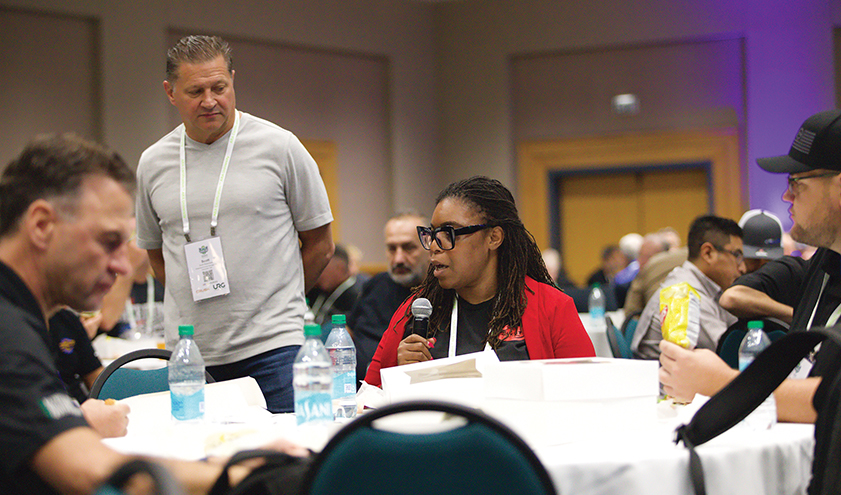
Walking into ARA changed that. The training was thorough, and the conference was well produced. You could tell the association genuinely invested in putting something together worth attending. But what moved me most was simply being around people who understood this business at a level I had never had access to before. I sat at tables with operators who had been running yards for thirty years or more. That kind of insight and experience is not something you find in a manual or a webinar. You have to be in the room to get it.
I left energized, connected, and clear that this would not be my last convention. Next time, I am bringing team members with me. That is how valuable I believe the exposure is.
If you have been on the fence about ARA membership or attending the convention, I would tell you the same thing I tell operators about AI: stop waiting. The investment is worth it.
The room is worth it. And you will wonder why you waited so long to walk into it.
AR: As a Woman-owned, Black-owned, local business, what does it take to succeed and rise above obstacles?
Broxton: You have to be willing to be the first and not let that slow you down.
There were rooms I walked into where no one looked like me. Deals I had to work harder to earn. Credibility I had to demonstrate before it was assumed. I am not going to pretend that it is not real, because it is. But I also refuse to let it be the loudest part of my story.
Your differentness is not a disadvantage. It is a competitive edge if you are willing to use it strategically. The certifications that opened supplier diversity doors. The visibility that came from being the first to do something in a market. The relationships that formed because people remembered you. None of that happens if you look like everyone else.
Do the work. Build the systems. Tell your story. And find the people and the associations that will help you grow, because you do not have to figure this out alone.
AR: You have an impressive Press Media Toolkit on your website. Why should all recyclers have one?
Broxton: You cannot control when opportunity shows up, but you can control whether you are ready for it.
A journalist on deadline does not have time to wait for you to pull your story together. A conference organizer needs to evaluate you quickly. A corporate buyer wants to see credibility at a glance.
Your media kit does that work before you are ever in the room. It tells your story, documents your credentials, provides approved images, and gives anyone who encounters your business a reason to take you seriously immediately.
Every recycler has a story worth telling. Most of them are just not packaging it. Build the kit. You will be surprised how many doors it opens.
AR: You have done many media interviews. Why is this important, and how can other recyclers do the same?
Broxton: Media coverage is compounding credibility. Every feature, every interview, every mention builds a record of legitimacy that lives online and works for your business long after the original publication date.
I have been featured by Black Enterprise, TMJ4, America’s Black Forum, Verizon, Google, Shepherd Express, Women in Automotive, Auto Recycling World, and others. That coverage did not happen because journalists found me randomly. It happened because I made myself findable, I had a story worth telling, and I was ready when the opportunity came.
The path for other recyclers is the same. Build your media kit. Develop a clear point of view on something happening in the industry. Engage with your state association and ARA because media relationships often run through those channels. And when someone asks if you want to participate, say yes. This article is a perfect example.
Caryn reached out. I said yes. That is how it works.
AR: What advice would you leave with auto recyclers?
Broxton: Stop waiting for the industry to tell you when it is time to modernize.
The recyclers who will lead this industry in the next decade are not the ones with the biggest yards or the most vehicles. They are the ones who build the best systems. Systems that run consistently regardless of who is working. Systems that capture knowledge before it walks out the door. Systems that use technology to do what people should not have to do manually.
AI is available right now. It is not as complicated as it sounds, and it is not as expensive as you might assume. The barrier is not access. The barrier is knowing where to start.
Start where the money is leaking. That is the only advice you need.
Natasha Broxton is Founder of Alitura Group, the only operator-led AI modernization firm focused specifically on automotive recycling. Learn more at AlituraGroup.com/start.