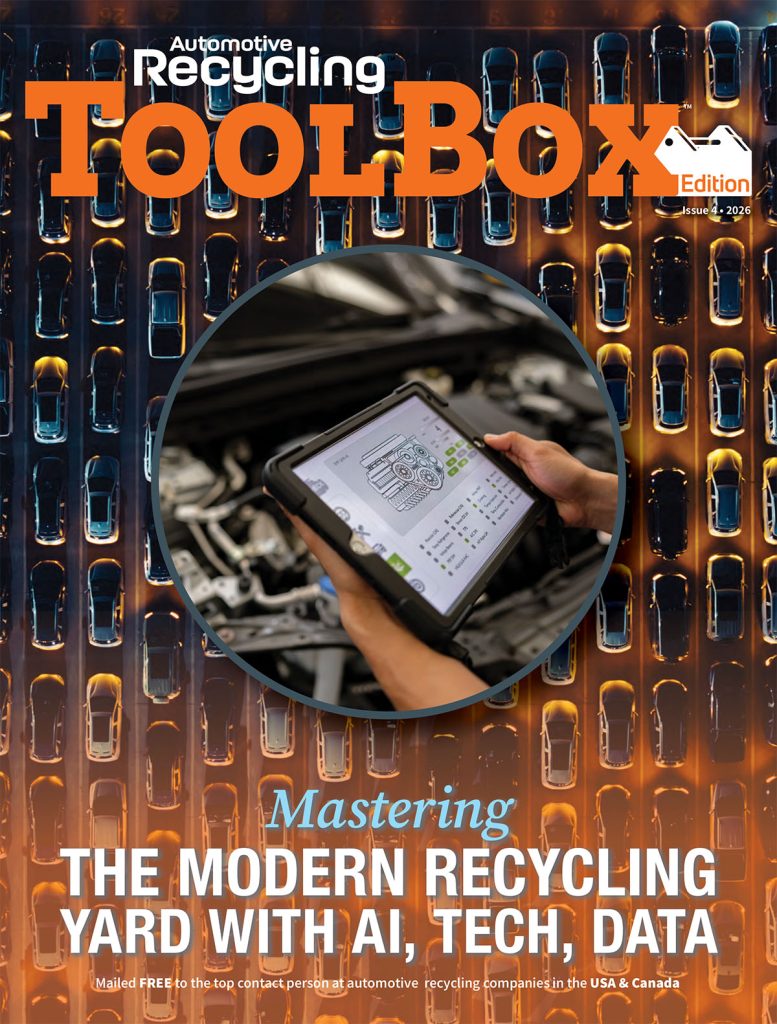
AI is helping automotive recyclers turn years of operational knowledge into smarter systems, faster decisions, and new revenue opportunities.

Before Voice AI, we were capturing 61 percent of our inbound calls. That means nearly four out of every 10 calls were going unanswered.
Customer communication, inventory management, pricing decisions, and vehicle purchasing are all likely to become more data-driven.
Artificial intelligence (AI) is quickly moving beyond experimentation and into practical application across the automotive recycling industry. While early conversations often focused on AI as a content-creation tool or a futuristic technology, recyclers are increasingly finding that its greatest value may lie in solving everyday operational challenges.
For an industry built on experience, relationships, and specialized knowledge, AI is creating new opportunities to capture institutional expertise, streamline repetitive processes, and help businesses make faster, more informed decisions. From inbound call management and customer communication to inventory optimization, vehicle valuation, parts pricing, and purchasing decisions, AI is becoming a tool that allows recyclers to operate more efficiently without losing the expertise that has historically driven the industry.
“The bigger opportunity for automotive recyclers is operations,” says Natasha Broxton, founder and CEO at Select Auto Parts & Sales, Inc. “This industry has always depended heavily on experience. The challenge is that experience often lives in one person’s head.”
That challenge is especially familiar to owners and operators who have built their businesses over decades. The knowledge required to evaluate a vehicle, determine its value, understand which parts are in demand, manage customers, and make purchasing decisions often develops over years of hands-on experience. But when that knowledge remains with one person, growth becomes difficult.
Broxton says AI provides a way to transfer that expertise into systems that can support an entire team.
“AI gives us the ability to capture some of that knowledge, document it, and make it accessible to other people on the team,” she says.
For Broxton, the most meaningful applications have not been about creating content or using AI as a novelty. They have been working on building systems that allow her company to operate more effectively.
“The operators who are getting the most value are the ones who are starting with a business problem instead of starting with a tool,” she says.
Chris Daglis, founder and CEO of Ari (Auto Recycler Intelligence), agrees that the biggest impact of AI is happening in areas where recyclers have historically accepted inefficiencies as part of doing business.
“The biggest impact is happening at the edges of the business that owners stopped thinking they could fix – inbound call handling, parts availability responses, buying of salvage vehicles and pricing parts,” Daglis says. “These are high-volume, business-critical tasks that have always consumed staff time without generating much strategic value. AI is taking those over.”
Rather than replacing the human expertise that defines automotive recycling, AI is helping operators extend that knowledge, improve consistency and create more scalable processes.
Turning Experience Into Systems
One of the biggest opportunities AI creates for automotive recyclers is the ability to transform individual expertise into repeatable processes. Broxton says that before implementing AI systems, much of her company’s operational knowledge existed only with her.
“I was the only person who knew how to price a junk vehicle accurately. I was the only one who could build a dismantle list. I was the only one managing the eBay store with the operational knowledge behind it,” she says. “I had a capable team, but they did not have 14 years of experience to draw from, and there was no system that held that knowledge for them. Everything ran through me.”
The first step was documentation.
“I used to have to stop what I was doing and write a process out manually. That almost never happened because something more urgent was always competing for my time,” Broxton says.
Using AI, Broxton began converting her knowledge into standard operating procedures, training documents, checklists, and workflows.
“Now I take a voice note from my phone, drop it into AI, and it becomes a standard operating procedure, a training document, a checklist or a workflow,” she says. “That one shift has changed how my team operates because the knowledge is no longer trapped in my head waiting for me to have time to explain it.”
That ability to document and distribute knowledge has significant implications for recyclers facing workforce challenges, employee turnover, and growth.
Avitesh Kesharwani, enterprise AI architect at Genpact, says many recyclers are looking for technology that addresses practical issues, including inconsistent cataloging, slow listing creation, poor visibility across locations, and parts sitting in inventory for too long.
“The problems being solved are very real,” Kesharwani says. “Too much manual inspection, inconsistent cataloging, wrong-part sales, slow listing creation, parts sitting in inventory too long, and poor visibility across yards or networks.”
The value of AI, he says, is not simply automation. It is improving the quality and speed of decisions.
Capturing More Customer Opportunities
For many recyclers, one of the most immediate applications of AI has been improving customer communication. Inbound calls represent a significant source of revenue but also pose challenges for businesses that receive requests outside traditional operating hours or when employees are managing other priorities.
Broxton experienced that challenge firsthand.
“We were losing junk car requests that came in at 2:00 in the morning,” she says. “By the time my team arrived Monday morning, those leads were already cold. The customer had moved on.”
The company implemented AI systems designed to capture those inquiries and begin the customer process immediately.
The results were measurable.
“Before Voice AI, we were capturing 61 percent of our inbound calls,” Broxton says. “That means nearly four out of every 10 calls were going unanswered.”
With 2,000 to 3,000 calls per month, that represented a significant missed opportunity.
“After implementation, our call capture rate went above 90 percent. Same call volume. Same team size. No additional headcount. The difference is that every call gets answered now, regardless of what time it comes in or how busy my team is.”
Daglis says customer expectations are continuing to shift, making fast communication increasingly important.
“Buyers expect fast responses across phone, web and marketplace channels simultaneously,” he says. “That’s impossible to staff cost-effectively. AI-powered messaging and chat are closing that gap without adding headcount.”
At Ari, AI-powered tools are designed specifically for automotive recyclers, handling repetitive communication while allowing employees to focus on situations requiring judgment and relationship-building.
“The recyclers pulling ahead share one trait: they stopped treating AI as an experiment and started treating it as infrastructure,” Daglis says. “Set it up properly, manage it consistently, and it compounds over time.”
Improving Inventory and Parts Sales
Inventory optimization represents another major opportunity for AI adoption. Automotive recyclers manage thousands of parts, but maximizing revenue depends on accurately identifying, describing, and connecting those parts with the right buyers.
Daglis says AI is helping recyclers improve how they discover and sell inventory.
“On eBay and other marketplaces, recyclers using AI-assisted listing optimization are seeing meaningful improvements in search ranking and conversion because the listings finally reflect what buyers are actually searching for,” he says.
AI can help standardize descriptions, improve search visibility, and ensure listings include the information buyers need to make purchasing decisions.
“Many recyclers have valuable parts, but the value is limited if those parts are hard to find, poorly described, missing fitment details, or not visible to the right buyer,” Kesharwani says.
Broxton has also used AI to support her eBay operation, helping improve listing optimization and create more consistent processes. For recyclers, the opportunity is not simply creating more listings. It is creating better listings that help buyers find the right parts faster.
Daglis says industry-specific AI solutions have an advantage because automotive recycling requires specialized knowledge.
“Generic AI doesn’t know the difference,” he says. “Ours does, because the rules were written by people who’ve lived in this industry.”
That industry-specific approach also extends to vehicle purchasing and salvage decisions.
AI-powered systems can analyze market demand, inventory gaps, and purchasing opportunities to help recyclers make more informed acquisition decisions. Instead of relying solely on intuition or historical experience, operators can use data to identify which vehicles are most likely to produce profitable returns.
Building a Digital Profile
One of the most promising applications of AI is improving how recyclers evaluate vehicles when they first enter the yard. Historically, identifying vehicles, documenting available parts, and determining potential value has required extensive manual effort and significant reliance on experienced employees.
AI is changing that process by helping connect the physical vehicle with the digital information needed to make faster decisions.
“AI acts as the vital link when a vehicle arrives at a dismantling facility, helping to match the physical car to its digital footprint,” says Ben Pope, COO of Sortera Technologies. “By using this data, AI can seamlessly catalog which parts are available for resale, which components should be routed to a remanufacturer, and which elements are ready for the destruction and shredding phase.”
Computer vision, a form of AI that allows systems to interpret images and visual information, is particularly valuable in this environment. Instead of relying only on manual inspections, AI systems can analyze photos and available data to help identify vehicle characteristics, damage levels, and potential inventory opportunities.
Kesharwani says AI can evaluate multiple sources of information simultaneously, helping recyclers make better decisions even when vehicle details are incomplete.
“If a vehicle comes in damaged and the exact trim is unclear, AI can compare photos, visible components, wheel type, headlight shape, interior features, engine bay details, and VIN-related information to suggest the most likely configuration,” he says.
This capability can help recyclers create more accurate inventory records while reducing administrative time. AI-generated recommendations for part descriptions, fitment information, condition notes and marketplace listings can help improve the quality of data entering a recycler’s systems.
However, industry experts emphasize that AI is not replacing the experience of professional dismantlers. Human judgment remains essential when evaluating hidden damage, corrosion, aftermarket modifications or other conditions that may influence resale value.
Instead, AI serves as a decision-support tool, allowing experienced employees to focus on higher-value evaluations while reducing time spent on repetitive documentation.
Improving the Buying Process
For many recyclers, purchasing salvage vehicles is one of the most important decisions affecting profitability. Buying the right vehicles at the right price requires understanding market demand, parts value, and future sales potential.
Daglis says AI is beginning to transform salvage purchasing by helping recyclers shift from reactive to more strategic buying decisions.
“Yards can now see a complete picture of inventory leakage – what’s not being bought, what’s being underpriced, where demand exists that their current stock isn’t capturing,” he says.
AI-powered tools can analyze purchasing trends, inventory needs, and marketplace demand to help recyclers identify vehicles that align with their business goals.
At Ari, one application focuses on helping recyclers identify vehicles containing parts they need.
“Ari Hunter is a scout that never sleeps,” Daglis says. “It understands exactly what parts your yard needs, then searches every auction you point it at to find the vehicles carrying them.”
Rather than spending hours manually reviewing auction listings, recyclers can use AI to identify potential opportunities and make more informed purchasing decisions.
This shift represents a broader change in how recyclers can use technology. Instead of simply reacting to incoming vehicles, operators can use data to proactively identify opportunities before competitors.
Recovering More Value
While reusable parts remain a major focus of AI adoption, the technology is also creating new opportunities in material recovery.
The automotive recycling industry has long faced challenges when processing mixed materials. Traditional sorting methods can be labor-intensive and may limit the value recovered from end-of-life vehicles.
Pope says AI-powered sorting technology is changing that equation.
“Because mixed automotive scrap is complex and difficult to catalog, traditional methods have relied on manual sorting or mass shredding,” he says. “The introduction of AI changes this completely by providing the ability to visually see, accurately classify, and quantify materials in real time.”
At Sortera, AI systems monitor materials moving through processing lines, gathering data that helps identify and separate materials based on value.
“We use live monitoring software that looks closely at each individual piece of material on the line, gathering continuous information to feed our AI so it can instantly upgrade that material to its most valuable application,” Pope says.
As demand for materials such as aluminum, copper, and other critical metals increases, improved sorting capabilities may become an important competitive advantage for recyclers. The ability to recover more value from each vehicle also aligns with broader industry efforts to increase sustainability and support domestic material supply chains.
The Human Element
Despite the opportunities AI presents, successful adoption depends on how technology is implemented. Experts agree that AI should support employees rather than replace the expertise that drives the recycling industry.
Broxton says the most important change AI has brought to her business is reducing the operational burden that previously fell on her personally.
“The biggest change is that I no longer have to personally carry every process, decision and piece of knowledge inside the business,” she says.
By documenting processes and creating systems, Broxton has enabled employees to access information that previously required years of experience.
“Someone who is new to the business can now access processes, procedures and operational knowledge that took me years to develop,” she says. This approach allows smaller operations to compete more effectively by creating systems typically associated with much larger organizations.
Daglis says the recyclers that succeed with AI will be those that view it as a long-term operational investment rather than a temporary experiment.
“The recyclers pulling ahead share one trait: they stopped treating AI as an experiment and started treating it as infrastructure,” he says.
Preparing for the Future
While AI adoption is still developing, the long-term impact on automotive recycling could be significant.
Over the next five to 10 years, experts expect AI to become increasingly integrated into nearly every stage of the auto recycling process.
Daglis believes the role of employees will evolve as AI takes over repetitive tasks.
“The yards that thrive in ten years will look fundamentally different from the ones that thrive today—not because the core business changes, but because AI will have absorbed everything around it that currently consumes the most time and produces the least return,” he says.
Customer communication, inventory management, pricing decisions, and vehicle purchasing are all likely to become more data-driven.
“Phone calls as the primary buyer interaction channel will decline,” Daglis says. “AI-powered search, instant availability confirmation, and automated quoting will handle the majority of buyer inquiries without human involvement. Staff will move from order-takers to relationship managers and problem-solvers.”
Kesharwani expects AI to become increasingly involved in operational decision-making.
“The biggest change is that AI will move closer to day-to-day operational decision-making,” he says. “It will not just be a reporting tool or a chatbot.”
For recyclers considering where to begin, Broxton recommends focusing on practical problems rather than technology itself.
“When recyclers ask me where to start, I tell them the same thing every time,” she says.
“Don’t start with tools. Start with one problem. Find where time is being lost, where money is leaking, or where your team is struggling to execute consistently. Start there. The right tools usually become obvious after that.”

Based in Minneapolis, Minnesota, Maura Keller is a seasoned writer, editor, and published author, with more than 20 years of experience. She frequently writes for various regional and national publications.