“Watching experienced industry representatives present key issues, answer questions, and engage with lawmakers gave me confidence—I feel better prepared to take a more active role in future meetings.”
—Amberay Novak, Industry Specialist, Hub Industrial
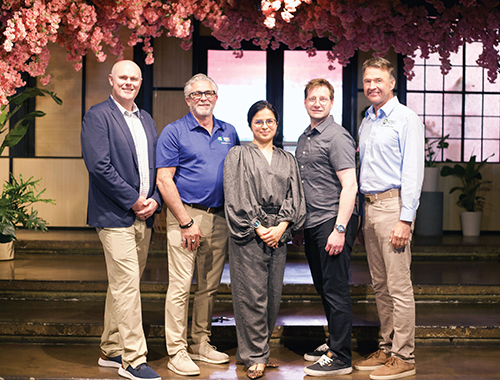
For decades, the relationship between OEMs and professional automotive recyclers has been defined by a competitive reality—recyclers sell recycled OEM parts, and automakers sell new ones. Collaboration was rare, and invitations were rarer. That is what made the presence of two Toyota Motor North America engineers from the Regulatory Affairs & Environmental Sustainability/Chemical & Materials Stewardship division at ARA’s Hill Days so remarkable.

Mark Bacchus, Senior Manager, and Tina Singh, Principal Engineer, Battery EPR & Circularity, did not come to lecture—they came to listen, share candidly, and work the problem alongside the recyclers in the room. As Bacchus told the group, “We literally would never have been invited to this five years ago—not because there was tension, we just sort of coexisted. But now we have to come together. And it’s happening.”
Mark Bacchus: “We’re Codependent on Each Other Now”
Bacchus set the stage with a picture of just how big Toyota’s stake in this conversation is. Roughly 80 percent of what Toyota sells in the U.S. is made here, and the company recently broke ground on a battery manufacturing facility in North Carolina that he estimates is up to six times the size of Tesla’s Gigafactory. “That’s going to give you an idea where things are headed,” he said. “A lot of electrification coming.”
Toyota’s “multi-pathway” approach spans hybrids, plug-in hybrids, battery electrics, and fuel cells—and it has not wavered with the political winds. “We have not changed our path at all,” he said. “We know that carbon is our main opponent here, not politics.”
Circularity—keeping materials in use instead of in landfills—is the driving theme, and Bacchus was frank that today’s reality falls short of the ideal. The reasons to close the loop are not just environmental, but economic and political: “The U.S. government doesn’t want to become dependent on China for certain materials. By making this fully circular, we become less dependent on raw materials coming from other parts of the world.”
Most encouraging for the room was where Bacchus sees recyclers fitting in. Toyota is already partnering with dismantlers across the U.S.—teaching them how to safely disassemble fuel cell tanks and taking honest feedback back to its R&D teams so vehicles are designed to come apart more easily, like the new Prius wire harness that releases with a couple of tabs instead of a cutting tool.
And while Toyota is building a “Circular Factory”—a full disassembly and recycling operation—next to its assembly plants in Europe, Bacchus made clear he would not recommend that model stateside. “My personal opinion, which I would put to our top leadership, is to focus mainly on partnering with folks like you guys,” he said. “Hey, I need 100 Corolla bumpers—can you get me 100 Corolla bumpers by next month? You guys already have the infrastructure. Why would we build infrastructure that’s completely different?”
He did not sugarcoat what is coming. Europe’s reformed end-of-life vehicle regulation will impose recycled-content requirements—including a closed-loop share that must be traced back to actual vehicles—along with recycler verification audits and a digital product passport. “Huge, huge regulatory barrier for us,” he admitted, adding that Toyota will be working with ARA to navigate it.
His answer to keeping counterproductive regulation out of the U.S.? “We don’t go on defense—we go on offense.” The very next week, Toyota planned to bring officials from the State Department, Department of Commerce, and EPA to see firsthand the realities of dismantling and shredding.
His closing request to recyclers was simple: keep talking. “We are not experts in your work,” he said. “We’re codependent on each other now. Before, we existed in our happy little silos—but now we need to work together on all these issues.”
Tina Singh: “We Need to Take Ownership”
Singh, who has spent the past ten months learning directly from recyclers, opened with the industry’s “problem child”—the traction battery, which can run anywhere from 500 to 2,000 pounds.
“I’m not going to pretend I’m the expert,” she said. “You guys have been teaching us what goes into removing the battery from the vehicle, storing it, putting it on a truck—and all the liability that comes with that. Thank you in advance, because we’re going to continue learning from you.”
She visited an ARA member facility last July and saw the training, the battery stickers, the discharge equipment, and the sheer difficulty up close. “You guys have the infrastructure. You guys have the training. We have a lot to learn from you.”
With at least eight states eyeing EPR legislation—and a costly patchwork of conflicting requirements looming—Toyota helped form a coalition ten months ago, with ARA among its first members, to craft model legislation for traction batteries and hand regulators a framework the whole supply chain agrees on.
That model shaped Colorado’s landmark bill: “Colorado took almost 90 percent of our model bill language,” Singh said, noting it was called “the most negotiated bill they’ve ever seen”—more than 20 negotiation sessions with the bill’s authors.
Then came the announcement with real dollars behind it: Toyota’s industry-facing battery collection pilot, targeting the stranded batteries collecting dust in recyclers’ yards. “We know that we need to take ownership of end-of-life batteries, especially stranded batteries,” Singh proposed.
In general terms, she explained that a potential three-year pilot—projected to launch first in California, Oregon, and Washington in late 2026, early 2027—was in the works. The recycler decides whether a battery has a place in the market or is stranded. Send Toyota a photo of the battery, proof of state registration, and a DOT hazmat training certificate, and Toyota sends the proper packaging and a freight truck—responding within 14 days and collecting within 60—and takes on the full cost of managing the battery from there.
Marketable batteries stay with the recycler to sell. And to the skeptics who asked about Toyota’s motive, Singh was refreshingly candid: “Every battery that stays in the management hierarchy, we don’t have to pay more. That helps everyone.”
Looking ahead, Singh confirmed Toyota’s EV batteries will carry battery identification numbers and QR codes—with plans for a website that auto recyclers can access to understand a battery’s history. It is all part of a strategy she believes makes the industry’s case unbeatable. “Toyota going to the policymakers is great,” she said. “But Toyota with ARA, with recyclers, with the coalition going to the policymakers and saying the industry wants to use this framework—how are they going to argue with that? Let’s keep collaborating.