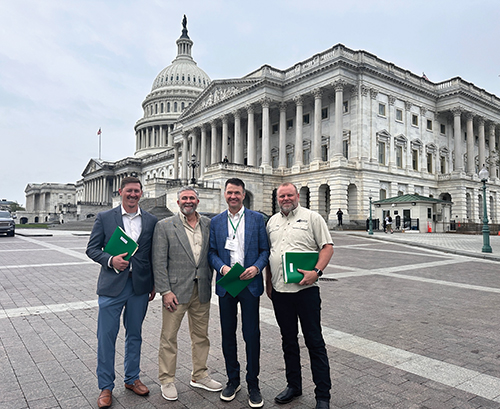
The ARA Government Affairs Committee work for the industry is accomplished though dedicated volunteers with their pulse on regulatory activities that can impact the ability to do business.
By Slater Shroyer

The 2026 legislative sessions are well under way and ARA has already seen several issues rise to the top of our priority list. Many will directly impact our members and the automotive recycling industry. Some state bills are setting the stage to become national models that other states will follow. A few issues are new and others have been evolving for years. As we prepare for ARA’s Hill Days, we believe it is important for our members to know and understand everything we are working on, and why they are important.
Catalytic Converters
Catalytic converters contain rare platinum group metals. Platinum, palladium, and rhodium prices rose precipitously during the COVID pandemic due to global supply chain issues. The price per ounce fell precipitously as global supply chains stabilized and forecasts predicted decreased demand for catalysts due to the prospect of vehicle electrification.
Over the last year, platinum group metals prices have risen steadily. These price increases are due to a resurgence in catalyst demand resulting from the elimination of tax credits for electric vehicles and claw backs of emissions regulations. As converter values increase, the incentive to steal them also increases. Most catalytic converter bills are focused on theft prevention during periods of heavy theft. This is where the Preventing Auto Recycling Theft Act (PART Act) comes in.
The PART Act has been reintroduced by Congressman James Baird (R-IN-4) to reduce catalytic converter thefts by requiring identifying markings and stricter recordkeeping. It has bipartisan support. ARA is one of over 120 associations supporting the PART Act and has been working with the bill sponsors and coalition on amendment language to strengthen the bill’s language.
Another focus for ARA relating to catalytic converters is on reuse. The current stance on converters is based on an enforcement memo from 1986. That document allows for the recertification of converters for use as replacement parts but fails to set out clear instructions for testing and certification. ARA has petitioned EPA to revisit their language to make reuse of converters a more feasible option for recyclers and repairers. This will help vehicle owners afford replacement catalytic converters while improving our nation’s air quality.
High Voltage Batteries
Understanding the legal landscape around high voltage propulsion batteries requires an understanding of how chemistry changes value. Early hybrid batteries had a nickel base, but they aren’t as energy-dense as lithium-ion batteries and they have a higher self-discharge rate. Several hybrid models still use nickel-metal hydride batteries, but most batteries have moved to lithium-based chemistries.
Until recently, most lithium batteries used cobalt, a dark blue crystalline metal that is primarily mined in Democratic Republic of Congo. For context, cobalt is currently worth about five times the price of copper, which explains why batteries that contain it have a comparatively high recycling value. That cost is also the primary reason that battery manufacturers have spent years working to eliminate it from batteries.
Many manufacturers have moved to lithium-iron phosphate (LFP) batteries. LFP batteries are less energy dense than cobalt based batteries, but they offer superior longevity, are less prone to thermal runaway, and are cheaper to manufacture since they don’t contain nickel or cobalt. Unfortunately, this means that there aren’t high-value metals to reclaim in the recycling process. LFP batteries often have zero or even negative value to battery recyclers. This creates a huge potential problem.
Several states have introduced legislation over the last year that focuses on extended producer responsibility for batteries. New Jersey is the only state to have a law that regulates vehicle battery recycling. California, Florida, New Mexico, and Washington all had bills last year that could have dramatically changed the legal environment for working with high-voltage vehicles. New York had language which would have incorporated large-format propulsion batteries over an existing framework for small format batteries. Colorado SB26-003 has a high likelihood of passing and becoming a model framework for other states. Furthermore, the federal government is also working to develop a framework to manage high voltage vehicles and their batteries throughout their life cycles.
ARA has taken an active role in shaping these bills as we realize the future of the industry is reliant on their outcomes. We are actively involved in committees, associations, and standards bodies that are driving policy and drafting legal frameworks. We are working with manufacturers and battery recyclers to reach consensus on the most important issues. These conversations have helped all the stakeholders to develop a better understanding of safety, environmental, and economic concerns up and down the value chain.
There are other issues to consider about high voltage batteries beyond just their economic value. Illinois recently passed legislation that required batteries be sent to automotive recyclers. The Illinois EPA responded by proposing 50 pages of compliance rules.
UN 3480 currently requires lithium-ion batteries on cargo planes to be discharged to 30% state of charge. After a truck fire in Nevada closed the interstate for two days in 2024, Congresswoman Dina Titus (D-NV-1) introduced the Thermal Runaway Reduction Act which would have required the same state of charge for ground transportation. There is still no universal way for handlers to determine state of charge once a battery has been removed from the vehicle.
The National Fire Protection Association (NFPA) standard for lithium-ion batteries presents a new set of rules and regulations for fire prevention.
The ARA Government Affairs Committee is tasked with developing a comprehensive position statement that reflects the goals and objectives of the automotive recycling industry. We plan to have a tangible document ready before convention.
Aftermarket Parts, Repair Procedures, and Right to Repair
Aftermarket parts sales restrictions can have several effects on the recycled parts industry. UT 119 is a very short bill that requires insurers to inform customers in writing whenever non-OE parts are used in vehicle repair. ARA reached out for clarity as some readings suggest the restrictions extend to recycled OE parts while others state they do not.
OH HB 636 contains similar provisions. Georgia’s HB1420 goes a step further and requires that all insurance policies must reimburse for repairs that follow OEM repair procedures which could include the use of OE supplied replacement parts.
Meanwhile, last year, a new judge finally dismissed the federal court case in Massachusetts over the state’s right-to-repair law. The law, based on a 2020 ballot initiative that passed overwhelmingly, gives owners and independent repair shops access to repair and maintenance data through vehicle telematic systems. It was quickly opposed by manufacturers and went into limbo until a bench trial in 2021. Two years later the presiding judge dismissed 6 counts but kept two open. The case sat in limbo waiting for a ruling until February of last year when the replacement judge expedited the case and issued a decision. The Alliance for Automotive Innovation appealed the decision a month later.
While the Massachusetts case was sitting without a ruling, Maine passed a similar “right-to-repair” law in 2023. Maine’s legislature passed a bill LD1228 that made substantial changes to the law replacing “independent entity” with a commission that lacked rulemaking authority and eliminating the requirement to equip vehicles with an “inter-operable, standardized and owner-authorized access platform.” Maine’s governor vetoed LD1228 this past January.
Tariffs
Tariffs have become an issue for recycled auto parts being shipped between the U.S. and Canada. The heart of the issue is that recycled parts from end-of-life vehicles do not always have clear countries of origin. Modern automobiles are assembled from parts that are shipped to plants from all over the globe. This creates a unique challenge for businesses that dismantle vehicles that may have been assembled in one country but contain parts that could be manufactured from anywhere. ARA has petitioned the White House in April 2025 for an exemption from tariffs as it is impracticable to identify countries of origin, the value of used parts is subjective in nature, and decreasing imports will cause a reduction in the reclamation of critical minerals within the U.S.
Hill Days
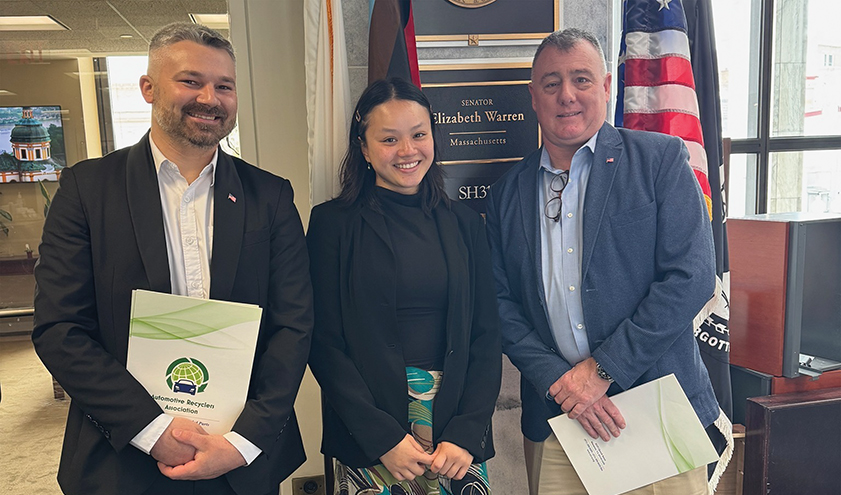
These issues represent just a fraction of the work ARA’s Government Affairs Committee and members are addressing every day on behalf of our members and the automotive recycling industry. From shaping high voltage battery frameworks at the state and federal level, to fighting for fair tariff treatment and championing catalytic converter reuse, ARA is at the table, participating on committees, building coalitions, and engaging with policymakers. ARA is working to ensure that our industry's voice is heard loud and clear.
Notwithstanding, advocacy is most powerful when it comes directly from the people whose livelihoods depend on the outcomes. That is why we are calling on every ARA member to join us for Hill Days. This is your opportunity to meet in-person with your elected representatives, share your firsthand exper iences, and demonstrate that automotive recyclers are a vital part of the American economy. The decisions being made right now will shape our industry for decades to come.
Don’t miss your chance to be part of them. Make your voice count. Register for Hill Days by visiting ARA’s website at www.a-r-a.org!.
Slater Shroyer is CEO of Shroyer Auto Parts in Lansing, MI.As an active volunteer in the automotive recycling industry, he is chair of the ARA Government Affairs Committee and also current president of the Automotive Recyclers of Michigan.