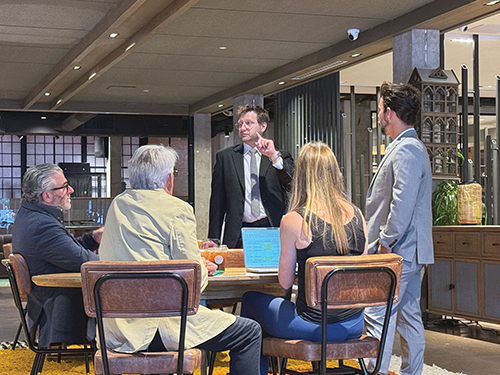
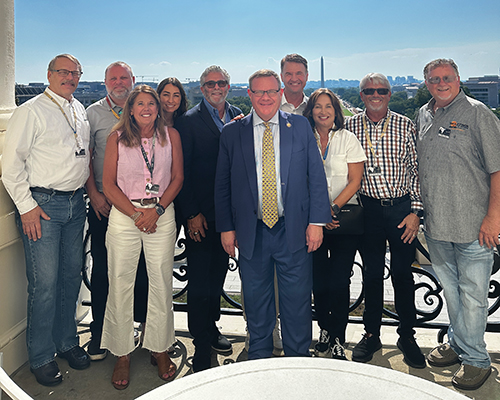
A look the hot topics for driving industry-wide change from ARA Hill Days held May 19–21, 2026 in Washington, D.C.

“The event was incredibly eye-opening. It allowed me to see firsthand the massive advocacy work ARA is doing on the ground to protect our industry… This was my first time attending, and it definitely won't be my last.”
Kristi Werner, CEO,
United Recyclers Group
“My second year, two out of the three people I met with were the same as the year before—and remembered me. That can be powerful if in the future I'm able to meet with them about important legislation.”
— Amber Kendrick, Owner, Pete's Auto Parts
When the automotive recycling community converged on Washington, D.C. this May for ARA’s Hill Days, the message from leadership was clear from the opening session: this is not an association that waits for legislation to happen to it. “Most trade associations are slow,” ARA Executive Director Vince Edivan told attendees. “At ARA, we’re trying to play offense. We want to be proactive about identifying trends and analyzing the surrounding environment. We frame emerging issues before the competition. We draft legislation rather than just comment on it.”
The proof is in the numbers—nearly 300 pieces of legislation and regulation monitored every year across 45 jurisdictions, including state, federal, and international; nine states where ARA has testified on behalf of the industry; and more than 13 external organizations and coalitions where ARA is actively engaged. As Edivan put it, “We are everywhere all the time.”
That offense-first mindset recently paid off in Colorado, where ARA worked hard on legislation addressing high-voltage vehicle battery processing—and it passed. “Once we’re able to get language that benefits our industry, or at the very least protects our industry, then we have the advantage of that language being used in other states,” Edivan explained.
“We shape the rules before they’re written.”
Several shared stories illustrated ARA’s seat at the table.
When Meeting with Legislators: Don’t Take No for an Answer
Getting an appointment on the calendar is only half the battle. Once you’re in the building, ARA veterans say the real skill is knowing how to talk to whoever is in the room —and how to stay in that room when the answer is supposed to be no.
Amber Kendrick, of Pete’s Auto Parts in Jenison, Michigan, has been coming to ARA events since she was five years old—“My first ARA conference, I got a new pair of boots and a hat, and I’ll never forget that.” She has learned to read her audience before she shares her point of view. “I’ve learned that when you meet with a Democrat, on any issue we want them to act on, you lead with how it is greener, better for the environment and better for their constituents,” she said. “For a Republican, you talk about how ’insane it is that a rule from 1986 is restricting all these businesses from being able to sell parts—that’s useless government obstruction.” This is about the same issue, two different doors in to the discussion.
Kendrick’s best advice came from a meeting that almost didn’t happen.
Last year, she had an appointment scheduled with Rep. Bill Huizenga—a member of Congress, which was then canceled prior to Hill Days. She had been on his mailing list of for twenty years and also had met with him before. When his office tried to brush her off, she didn’t let it go.
“I was pretty irritated that they couldn’t even get an intern to meet with me,” she said. She called his Lansing office. She called his D.C. office. When someone finally told her flatly there was no way, she went to the office anyway.
“They said that ‘there is no one that can meet you here.’ I figured that there are schedules changes all the time, so I decided to sit in their waiting room and read my book.” For the first twenty minutes, she could tell the staff assumed she’d give up. She didn’t. “I asked them if they had any water, they brought me a bottle. I was eating their snacks, and really just camped out. Then, magically, they found someone to meet with me.”
Her takeaway for first-timers: “Don’t just stop by, hang out for a while—they will talk to you if you’re friendly and you’re persistent.”
She also does her homework before every visit, scrolling a lawmaker’s Instagram and Facebook to see what their office has been posting about. When I am talking to them, I mention, “I saw that you voted for this, I saw that you are working on that—that’s an immediate way into a conversation.”
Persistence pays off in other ways, too, as Lance Thomas, BYOT Auto Parts in Elm Mott, TX, found out on his first Hill Days trip, where he was paired up with a fellow recycler Jason Howell, All Import Auto Parts in Fort Worth, TX, and his wife Chelsea Howell. It is important for this story to note that Chelsea she was the director of communication for the Fort Worth Police Department at that point. Thomas notes, “She’s like in her zone.”
He expected the meetings to go by the book—office, staffer, next office. Instead, conversations opened doors he wasn’t expecting.
Meeting with the office of Rep. Pete Sessions, the topic of local law enforcement came up, and Thomas mentioned he’d been struggling to get his county sheriff’s department to help with catalytic converter and parts theft. “Before I got back on the plane, the sheriff’s department was calling, excitedly, to set up a meeting,” he said. He went back home and actually got something done.
Then, there was an encounter Senator Ted Cruz. Thomas and Jason had tried three times to catch him in his office—working every angle with his staff, getting nowhere. “I’m like, I brought my boots, all the way from Texas, just to meet you,” he said of the pitch he never quite got to deliver. On their third pass through the building, they overheard a stranger on the phone say he was headed to lunch with Cruz—so they simply turned around and followed him back to the senator’s office.
Ten minutes of waiting in the hallway later, Cruz appeared. “I stopped and took out our ARA folder and talked to him for a minute, and then we took pictures,” Thomas recalled. It became one of his favorite Hill Days memories, alongside this Hill Days unplanned visit to the Speaker’s balcony and an up-close look at the World Cup trophy. “You just don’t know what’s going to happen,”
He said. “I wasn’t expecting any of it.”
The lesson from both: showing up is the price of admission, but staying—in the waiting room, in the hallway, in the follow-up call—is what actually gets the industry’s story told.
Leading the Charge on EV Battery Policy
With ARA Director of Government Affairs Emil Nusbaum home welcoming the recent arrival of his first child—happy news shared to the attendees—Slater Shroyer of Shroyer Auto Parts in Michigan, Chair of the ARA Government Affairs Committee, stepped up to lead attendees through the issue briefs and how to tackle their appointments on the Hill.
Before getting to the issues to be discussed on Capitol Hill by attendees, he opened with a short presentation on ARA’s progress made on the EV front.
The question that every recycler in the room would soon face from congressional staffers: Why do EVs matter? While EV sales dipped last year along with all vehicle sales, Shroyer noted they continue to claim a larger share of the market. “They’re not going away,” he said, “and they’re still predicting that there’ll be 30 million EVs to be the road by 2030.”
At the backbone of ARA’s EV mission is the hierarchy of best use—a framework the committee developed with a national laboratory, with Nusbaum instrumental in its creation. The premise is elegantly simple.
“The highest economic value for a battery also happens to be the highest environmental value,” Shroyer explained. Reuse comes first—“you don’t have to break into it, you don’t have to recycle it, you don’t have to shred it”—followed by repair or reconditioning, repurposing (a once-cottage industry now growing fast in solar and wind applications), recycling, and finally, the outcome nobody wants: disposal in a landfill. The higher up the hierarchy, the better for the environment—and the better for the recycler’s bottom line.
But the ground is shifting under the industry’s feet, and it comes down to chemistry. The nickel cobalt aluminum (NCA) batteries in big Tesla’s hold real recycling value because cobalt is rare and expensive—recyclers once redeemed $5,000 out of them. Now manufacturers are racing toward cheaper lithium iron phosphate (LFP)
batteries, and the economics have flipped upside down.
“In our world, these suck,” Shroyer said plainly, “because there is nothing of value in them to recycle.” A Ford Mach-E battery, he noted, “is going to cost you $1,400—plus the ride—to get rid of.” With Chinese automaker BYD exclusively using LFP and dominating markets overseas, negative-value batteries are the problem the auto industry must get ahead of.
“One way or the other, negative-value batteries are going to get stranded,” he warned.
That is exactly what Colorado Senate Bill 26-003 was built to solve. The legislation came out of an unlikely collaboration between the OEMs, ARA, battery recyclers, and environmental groups.
Shroyer credits Toyota with breaking the logjam:
“Tina Singh [engineer at Toyota Motors North America] came in and said, ‘Here’s the crazy part—you guys all think you’re way off in left field. We are talking to everybody, and you agree on 85 percent of what should go into these bills. Why don’t we just sit down and discuss the 85 percent we agree on and figure out if we can address the 15 percent we disagree on?’”
The result follows the hierarchy of best use—letting recyclers sell batteries when they can, with market forces working first and minimal government oversight—and if no market solution exists, the manufacturer comes to get the battery. The bill passed both houses nearly unanimously, and on June 3, 2026, Governor Jared Polis signed it into law—making Colorado the first state to adopt an EV extended producer responsibility law that sets specific recycling rate targets for critical minerals found in the batteries.
By 2031, recyclers must recover 90 percent of cobalt and nickel and 50 percent of lithium, with lithium recovery jumping to 80 percent by 2035, and starting in October 2028, propulsion batteries are banned from landfill disposal. Shroyer predicts it will be the model “in five or six states” in short order.
Nordstrom, who was briefed throughout the negotiations, ran the numbers the way any businessperson would. “You might have to pay a thousand bucks a year to be in the program,” he said. “I’ll pay a thousand bucks a year to get rid of the $1,400 Mach-E battery I can’t get rid of. That’s easy math for a businessperson.”
When Colorado needed recycler testimony on short notice, ARA’s ground game showed: with two phone calls, and members Norm Wright, Stadium Auto Parts, and Derick Corbett, SVP External Affairs at Pull-A-Part, were there. As Nusbaum likes to say, “We’re punching well out of our weight category.”
If the Hill Days auto recyclers are asked about legislative action on the EV side, the ARA Government Affairs Committee’s ask on the Hill is purposely focused—
$3 million as a placeholder appropriation to develop EV battery training, funding new online modules and safety equipment to reach beyond ARA’s 1,000-plus members.
It helps that ARA is one of the few associations offering broad industry-level training and education, along with a constantly updated database of EV batteries by model—freely available on the new ARA certification web page. “We have said for a while, as an industry, it is more important for us to get that out there than it is for us to try and monetize it,” Shroyer said.
Nordstrom closed with a word for the recyclers who shrug off the EV conversation. “So many of our members say, ‘I don’t care, because I don’t do EVs’—but they’re going to have to deal with EVs, whether they choose to or not,” he said. And the payoff extends well past batteries: “We’ve put a lot of energy into it, but it’s put us at the table now—to be involved and respected for other conversations that are coming up in the automotive world. We don’t want to be the one that has to solve the problem that they created. We want to be the white hat. We’re here to help. That’s where we’re going.”
Three Asks on the Hill
Before attendees fanned out for meetings with their state representatives and congressional staff, Shroyer led a final working session on the three legislative “asks” in each recycler’s issue brief and leave behind folder—and just as important, how to deliver them.
His advice: read the room. Talking to a Democrat? Lead with the environmental benefits. A Republican? Lead with the economics and the regulatory overreach. And gauge your traction honestly—“You’re having a conversation with a staffer, and you’re trying to gauge, am I getting any traction here?” he coached. If a representative or staffer shows interest, follow up with them after the event and let ARA know there is potential there.
These same three issues are ones every recycler can raise with their representatives from home—and here is what they need to know.
Ask #1: A Seat at the REPAIR Act Advisory
Committee Table
The bipartisan REPAIR Act (S. 1379/H.R. 1566) would establish a Fair Competition After Vehicles Are Sold Advisory Committee to advise the Federal Trade Commission on repair access and parts competition.
The committee currently includes 11 appointed industry representatives—and the automotive recycling industry is not one of them. That is a structural flaw, because auto recyclers are the primary supplier of recycled OEM replacement parts—parts with the same fit and finish as new OEM parts, at a fraction of the cost—representing an estimated 10 to 20 percent of parts sales in the country.
Notably, ARA is not asking members to support or oppose the bill itself. “We’re not saying we want you to support that act or oppose it,” Shroyer explained. “We’re saying if this happens, we want to be one of those listed.” The irony is hard to miss: the bill’s own language names salvage yards as parties affected by repair restrictions—yet leaves them off the committee.
As one attendee put it, “They name 11 sectors. They need to name 12. We’re 12 percent of the vehicle parts for every insurance job. We need to be in the conversation.”
Amber Kendrick, Pete's Auto Parts, offered the example she uses with her own legislators: “We’ve had customers who came in to buy a radio, and they literally couldn’t buy anything but an OE radio at the dealer, because there’s no way to reprogram that radio. How insane is it that I have 12 of these radios in my yard? I could sell them for $50, but we’re forcing the single mom to go buy an $800 radio straight from GM.”
The ASK: Support adding a representative of the automotive recycling industry to the advisory committee.
“This is our big ask this year,” Shroyer said. “Out of all the things, getting on this committee is huge for us.”
Ask #2: Modernize the EPA’s 1986 Catalytic Converter Reuse Policy
The EPA’s interim enforcement policy on catalytic converters dates to 1986—an era of leaded gasoline and no onboard diagnostics. Nearly 40 years later, the policy still discourages the reuse of functional OEM converters, even though the technology has transformed.
“Every car has OBD-II port now,” Shroyer noted. “There are sensors on the front and the back of the converter. It’s the car that’s telling us the converter is not working.” Meanwhile, an OEM converter is certified and built to last the lifetime of the car, while an aftermarket replacement—which only has to last one year or 25,000 miles—costs consumers anywhere from $1,000 to $3,000.
Nordstrom made the consumer case with an example anyone can picture: a mom-and-pop daycare whose minibus gets its converters hacked off, facing a six or seven thousand dollar dealer repair it cannot afford. “We have the original part. We want to put it back on the vehicle. The vehicle can test itself—everything since 1995 tests itself now,” he said. “It can help consumers and still do the job of taking care of the environment.”
The ASK: Urge the EPA to update the 1986 policy to allow reuse of used OEM catalytic converters that meet a modern, performance-based standard.
Ask #3: Support the PART Act to Deter Converter Theft
Catalytic converter theft is a national problem every legislator has heard about—the National Insurance Crime Bureau estimates thefts increased by 1,215 percent between 2019 and 2022, and experts estimate 600,000 to 700,000 converters were stolen in 2022 alone. What staffers may not know is that automotive recyclers are among the biggest victims—thieves endangering employees, criminal groups breaking into facilities, and recyclers purchasing vehicles expecting converters that turn out to be missing. The root of the problem is traceability.
“When police departments have talked to us, they said, when I pull over somebody and they’ve got a trunk full of sawed-off catalytic converters, there is no traceability,” Shroyer explained. “If there are no numbers on them, how do I prove that one of these is stolen?” The PART Act
(S. 2238/H.R. 5221) answers that—requiring OEMs to VIN-stamp converters, establishing record-keeping requirements for purchasers, codifying converter theft as a criminal offense, and creating one uniform federal standard in place of a patchwork of differing state laws.
The ASK: Support passage of the PART Act—a bill with broad bipartisan and coalition support that has come close to passing several times.
Recyclers can make an impact at home—a call or visit to a district office carries weight.
Research your senators and representatives position on issues. The industry’s voice is the strongest when it is everywhere—all the time.

Caryn Smith is the editor of Automotive Recycling magazine, and has been covering the industry for over 25 years. She is a freelance writer for industry publications, such as Recycling Today.