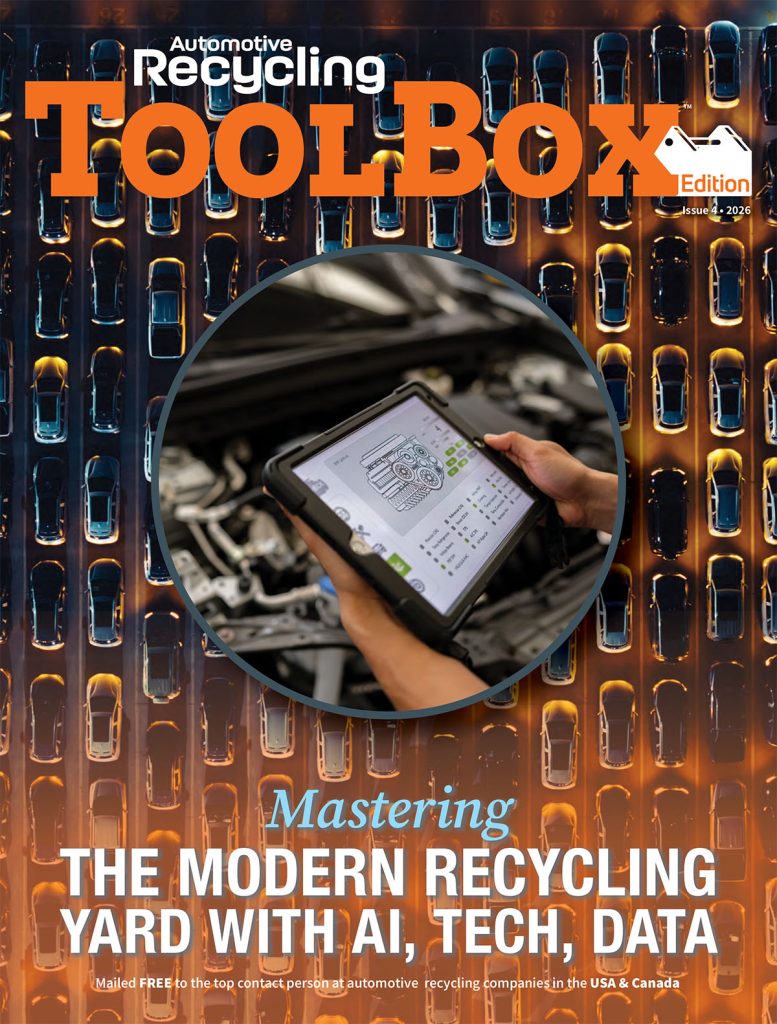
How to adapt your pricing, technology, and team to stay profitable in an era of EVs, AI, and changing buyer habits.
By Maura Keller

Clear expectations up front make a big difference. We establish payment terms early and enforce them consistently.—Josh Kuhn
In the automotive recycling industry, profitability is rarely about a single big win. Instead, it’s built on a steady rhythm of buying, dismantling, selling, and reinvesting—day in and day out. Cash flow can fluctuate with scrap markets, parts demand, seasonal trends, and even weather events, making consistency one of the greatest challenges recyclers face.
For operations that succeed over the long term, the difference often comes down to discipline, data, and a willingness to adapt. According to Shannon Nordstrom, president of the Automotive Recyclers Association (ARA) and owner of Nordstrom’s Automotive, maintaining strong cash flow isn’t about reacting to change—it’s about building systems that keep revenue moving regardless of market conditions.
“We are constantly buying and constantly dismantling, watching closely our parts activity,” Nordstrom says. “It seems that we have developed our systems and commissions in such a way that it pushes everyone to reach for the goals.”
Josh Kuhn, full-service director at Wilbert’s, agrees that the “secret sauce” is predictability. “Consistency starts with controlling what you can control: production and sales mix,” Kuhn says. “We focus heavily on maintaining a steady pipeline of vehicles to dismantle each week to keep inventory production stable. That gives sales a consistent flow of ’fresh product.’”
That consistency starts at the operational level, where aligning teams around clear targets can make all the difference. “We also let our team know with contests for everyone what our goals are on a quarterly basis,” Nordstrom adds. “It keeps people engaged and focused on what drives results.”
Still, even the best systems can’t eliminate volatility entirely. Scott Robertson Jr., president of Robertson’s Auto Salvage, points out that recyclers must plan for unpredictability rather than expect to avoid it. “All you can do is look at prior years’ periods to predict what sales should be,” he says. “Used part sales can fluctuate dramatically for a number of reasons—weather, economic uncertainty, inflation, availability of parts, and consumer confidence.” Because of that, he emphasizes the importance of financial preparedness. “The best thing you can do is get a line of credit from your bank to weather the ups and downs.”
Marty Hollingshead, president of Northlake Auto Recyclers, reinforces that point, noting that financial discipline is foundational. “While cash flow can be unpredictable, it is important to keep an eye on your bank balances, as well as having a reserve to draw upon when things get tight,” he says. “The best method is to keep an eye on your expenses, as well as having a budget to buy inventory.”
Seasonality adds another layer of complexity, particularly in self-service operations. Eric Wilbert, self-service director at Wilbert’s, notes that many recyclers must plan well in advance for predictable slowdowns. “In the self-service sector, almost every recycler goes through a slow period during the year… Northeast locations are slow during the winter months,” he says. “Typically, throughout the fall we purchase heavily; however, we keep our processing consistent in anticipation that retail parts sales will diminish in the winter months.”
Inventory: Walking the Line Between Asset and Liability
Inventory is the lifeblood of any automotive recycling business—but it can just as easily become a financial burden. Stock too little, and you miss sales opportunities. Stock too much, and cash gets tied up in parts that may sit for months—or years.
Striking the right balance requires a nuanced approach. “We are constantly trying to balance the fast-turning, higher cost of goods inventory with slower-turning, but lower cost of goods items to find a balance,” Nordstrom explains. “Twenty percent of the sales from the 80 percent of the slower turning inventory is important too.”
For Kuhn, the strategy at Wilbert’s revolves around strict turnover metrics. “The key is discipline around turn rate. We evaluate inventory not just on total value, but on how quickly it converts to cash,” he says. “High-demand parts, such as engines, transmissions, and late-model electronics, get priority in both purchasing and processing.”
Self-service yards approach inventory with a slightly different lens, balancing parts vehicles with scrap units to maintain flexibility. “At our self-service locations, we typically have two different types of vehicles we’re purchasing, one for parts and one solely as a scrap vehicle purchase,” Wilbert explains. “We do our best to set as many parts vehicles in the yard throughout the busy months and … process as many scrap vehicles during those slow winter months.”
Robertson challenges the idea that inventory itself is the problem, instead pointing to purchasing discipline as the real issue. “Inventory is never a liability; the cash flow it can eat up can cause some economic pain, but with good buying, money is well spent on inventory,” he says. “You can get into trouble with buying sales. You need to buy profits.”
However, Hollingshead views the inventory puzzle as a mix of speculation and systems. “Inventory does involve some speculation and a sizable investment,” he notes. “The thing to remember here is that sales and revenue are byproducts of your purchasing and inventory process. This is your system. Most profit comes from in-house sales.”
He adds a critical caution for buyers: strong purchasing discipline is what ultimately protects margins. The focus, he says, should always remain on building a system that supports profitable sales rather than simply accumulating inventory.
The danger, of course, is “dead money” sitting on a rack. Kuhn says that “letting inventory sit too long is one of the biggest hidden drains on cash flow in this business.” To combat this, Wilbert’s actively identifies and liquidates stagnant stock through price adjustments or bulk sales. “We also align purchasing decisions with real sales data, not gut feel,” Kuhn adds. “If it doesn’t sell, we stop buying it.”
Pricing in a Volatile Market
Pricing is another area where recyclers must stay agile. Scrap prices fluctuate, demand shifts, and external factors—from supply chain disruptions to economic cycles—can quickly reshape the market.
“In the last 18 months, pricing has been equalizing on so many items after the crazy highs that existed post-COVID,” Nordstrom says. This means recyclers have to be more calculated than ever. “I do remind our staff often, you still cannot lower the price enough to make someone buy an item nobody wants.”
Kuhn advocates a “dynamic but disciplined” approach at Wilbert’s, where pricing is adjusted based on demand and scrap values while staying within specific “guardrails.” He emphasizes that transparency is the best policy for keeping the customer base happy during fluctuations. “If they understand that pricing reflects market conditions and quality, they’re more accepting of changes,” Kuhn says. “Customers will pay slightly more if they trust what they’re getting.”
That same flexibility applies in self-service environments, where pricing often shifts with seasonal demand and inventory levels. “We have a dynamic pricing model that accounts for the commodity markets and most importantly the parts demand for each vehicle,” Wilbert says, noting that the margin strategy can change depending on supply and demand.
Robertson takes a hands-on approach, combining technology with daily oversight. “I utilize an AI pricing tool as well as adjust prices every day manually,” he says, underscoring how active management is required to keep margins intact in a constantly shifting market.
Unfortunately, pricing discipline is often overlooked. “Market dynamics are hard to quantify, but you can do it by identifying trends,” Hollingshead says. “The thing to remember here is that parts have value based on the market. What you paid for it is irrelevant.” He adds that maintaining pricing is “the most tedious, time-consuming, and most neglected task by most auto recyclers.”
Leveraging Technology
Technology has become an essential tool for recyclers looking to stabilize cash flow and improve profitability. From inventory management systems to online marketplaces and bidding platforms, data is now at the center of nearly every successful operation.
“We rely strongly on data from our Hollander YMS and use data from many sources and also our bidding tool Bid Buddy,” Nordstrom says.
Kuhn views technology as a major lever for efficiency. “Inventory management systems allow us to track turn rates, aging inventory, and profitability by part type, which directly informs purchasing and pricing decisions,” he notes. Wilbert’s is also pushing into automation for call handling and part identification to reduce labor costs. “Online marketplaces have expanded our reach far beyond local markets, increasing velocity on parts that might otherwise sit. The faster a part sells, the faster it turns into cash.”
For self-service operators, demand data plays an equally critical role in guiding decisions. “We rely heavily on customer demand search data… and utilize this to
dictate our buying model as trends evolve,” Wilbert says. “It is imperative to understand the opportunity each vehicle presents and maximize the revenue.”
At the same time, Robertson reminds recyclers that technology supports the business—but doesn’t replace fundamentals. “Those are selling tools, profits start with the buy, not with the sale,” he says. “You should be using all available tools to publish your parts for sale,” while also keeping a close eye on marketplace fees and their impact on margins.
Hollingshead agrees but sees room for improvement. “Your YMS is your best source for local data available,” he says. “The most helpful thing would be having external, aggregate data available… We need better technology for sure.”
Keeping Receivables in Check
Even with strong sales, cash flow can quickly become strained if payments are delayed. Managing accounts receivable is, therefore, a critical component of financial stability.
At Nordstrom’s operation, the CFO sets a strict tone. “Our CFO is very regimented, and we all follow that lead on credit apps, limiting first-time purchases to develop history and stopping charge accounts, regardless if they are tipping to the 90-day column,” he explains.
Kuhn follows a similar philosophy of setting expectations early. “Clear expectations up front make a big difference. We establish payment terms early and enforce them consistently,” he says. He also involves the sales team in the process. “We keep the sales team informed of customers’ receivables issues so they can address them with customers where necessary and appropriate.” Kuhn also suggests shifting to faster payment methods, such as credit cards or prepayment, for new customers to reduce reliance on extended terms.
Robertson notes that managing receivables is often a balancing act. “It’s a fine line in being too tough and making the sale,” he says, pointing out that flexibility may sometimes be necessary depending on the customer and market.
And Hollingshead underscores the importance of vigilance. “Watch your accounts receivable. Monitor them and make sure customers are following your terms,” he says.
“If they get behind with you, work out a plan with them to keep them as a customer and also to get paid.”
Controlling Costs
Profitability isn’t just about increasing revenue—it’s also about controlling costs and improving efficiency.
For many recyclers, that means taking a closer look at day-to-day operations.
“Standardization has been huge for us,” Kuhn says. “Clear processes for dismantling, inventory handling, and shipping reduce errors and wasted labor.” He also points to logistics as a major area for savings. “Shipping is a major cost, and tightening that up—through better packaging, routing, and carrier management—directly improves margins.”
Robertson adds that cost control requires a comprehensive and ongoing review of expenses. “Look at all costs and cut out the fat,” he says. “Next to the cost of goods, employees are the costliest, but also are your greatest asset.”
Hollingshead points to operational discipline as a differentiator. “Run a tight ship, have good processes in place to maximize efficiency and productivity,” he says. “Compliance and certification are the wisest investment you can make.”
Diversifying Revenue Streams
Relying on a single sales channel is rarely a winning strategy in today’s market. Diversification helps smooth out fluctuations and creates additional opportunities for growth.
Kuhn notes that at Wilbert’s, they’ve leaned into e-commerce, core sales, and scrap optimization to add stability. “Each of these adds stability,” he says. “When one market softens, another often offsets it, which smooths overall cash flow.”
Nordstrom uses a “many hooks in the water” strategy, selling to professional repairers and the DIY crowd through platforms like eBay and Facebook Marketplace. “It can be hard to do both, but we do our best to match our sales folks with the correct channels.”
Hollingshead adds a note of caution. “It’s a good idea to carry a deeper inventory, as well as adding some supplements,” he says. “But these are side dishes, and you need to keep enough resources to maintain your core.”
The Next Wave of Change
In an industry where margins can be tight and variables are constantly changing, keeping cash flow flowing requires more than just hard work – it requires strategy. From disciplined inventory management and dynamic pricing to leveraging technology and diversifying revenue streams, the most successful recyclers are those that take a proactive, system-driven approach to their operations.
And as the automotive recycling industry continues to evolve, recyclers must stay ahead of emerging trends—all of which can significantly impact cash flow. Nordstrom sees the shift toward mobile-first customers as a major hurdle. “The opportunity is huge, but you have to be wired for them to buy without talking to you.”
Robertson sees margin pressure as one of the biggest long-term threats. “Our cost of goods keeps going up. Our operating costs continue to rise. The price of our parts is not increasing to cover these cost increases,” he says. “Access to profitable inventory will be the key to our success in the future.”
Finally, Hollingshead believes technology will shape the future, but only if used wisely. “AI will play a huge role… as long as it is used as a tool and not taken literally,” he says.
“The companies that will thrive will use this technology coupled with knowledgeable humans.”
At the same time, he points to a timeless differentiator. “Focus on your drivers, know your numbers, and the numbers will take care of themselves.”

Based in Minneapolis, Minnesota, Maura Keller is
a seasoned writer, editor, and published author, with more than 20 years of experience. She frequently writes for various regional and national publications.