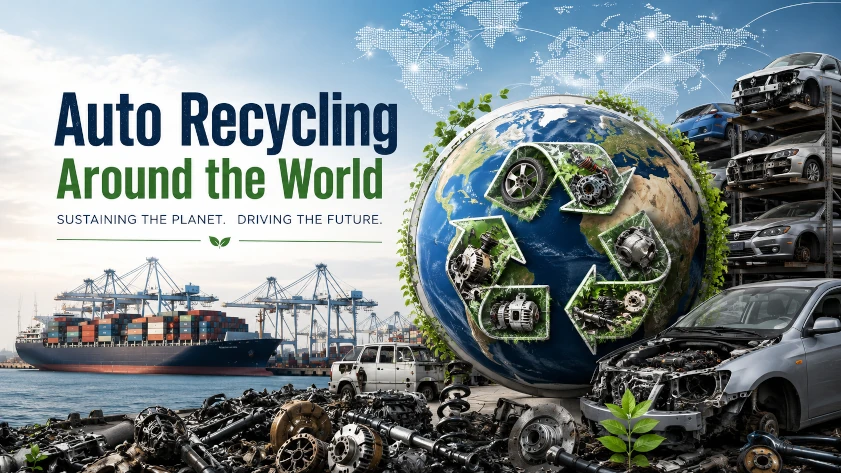
News from Korea, United Kingdom, and Canada
While global scrap prices vary by region, they are trending toward overall stabilization. Profitability in the resource sector is also stabilizing due to rising prices for recyclable materials (such as aluminum, copper, and catalytic converters).
Korea’s Automotive Recycling Industry
Korea News from the Republic of Korea and the Korea Automotive Recyclers Association (KARA)
By Johnny Jeong Howon

Automotive Recycling magazine: What news would you like the industry to know from your country and automotive recycling?
General Status of Korea’s End-of-Life Vehicle Recycling Industry
- Korea currently operates 570 officially registered end-of-life vehicle dismantling companies. (There are no unregistered illegal companies.
- While Korea generates approximately 800,000 end-of-life vehicles annually, the number of used vehicles exported is rapidly increasing (from 300,000 units in 2020 to 850,000 units in 2025).
- Domestic used parts sales are not increasing due to fewer car accidents, but used parts exports are rising in line with the volume of exported end-of-life vehicles.
- South Korea is institutionally striving to achieve a 95% recycling rate under its automotive recycling laws, which comply with ELV directives. The current recycling rate is reported at 92% (including thermal recovery).
- In recent years, electric vehicle recycling and automotive plastic recycling (ELVR) have become key topics within the industry.
Technologies and companies for electric vehicle recycling are rapidly expanding, and systems for remanufacturing, reuse, and recycling are either being implemented or are in preparation.
ARM: What are the current opportunities or challenges that your members are facing today?
Opportunities:
• Improved quality of Korean-made vehicles, increased preference in importing countries, and enhanced competitiveness in exporting scrap vehicles due to rising exchange rates.
• Particularly, increased exports of used and scrap vehicles to emerging markets.
• Expansion of the electric vehicle reuse industry.
• Policy momentum toward carbon neutrality.
Challenges:
- Increased scrap car acquisition costs due to competition among scrap yards. High acquisition costs for used electric and hybrid vehicles.
- Increased export volume of older vehicles driven by the vigorous activity of internet and auction-based used car exporters (without a corresponding increase in scrap car volume).
- The risks and complexity of handling electric vehicle batteries necessitate investment in safety facilities and performance-evaluation equipment.
ARM: What policies are affecting the right to sell recycled auto parts in your country?
South Korea broadly permits the sale of recycled automotive parts, but the following regulations exist:
- Braking and steering components cannot be reused (remanufactured or remanufactured parts are permissible).
- Remanufactured parts require quality certification.
- Airbags cannot be reused.
- To reuse end-of-life electric vehicle batteries (for other purposes, such as ESS or power banks), compliance with the ‘KC10031’ safety standard for reused batteries (Korean standard) is required.
- A policy requiring end-of-life electric vehicle high-voltage batteries to undergo remanufacturing or refurbishing before being sold for replacement in the same vehicle model is scheduled to take effect in 2027.
ARM: How is your association advocating for your members?
- Policy development and proposals to represent the interests of related industries and member companies (automobile manufacturers and importers, auto dismantlers, shredder companies, resource recycling companies, ASR incinerators, waste refrigerant treatment companies, etc.).
- Providing industry information and facilitating exchanges to promote resource circulation.
- Conducting research projects for the Ministry of Environment (industry status surveys, policy demand surveys, other R&D support, etc.).
- Supporting disassembly technology for electric vehicle batteries and drive motors, creating disassembly guidelines, etc.
- Supporting activities of other new associations related to electric vehicle recycling.
Furthermore, we strive to align with international best practices and cooperate with global automotive recycling associations, such as JARA, MAARA, AARA, MoARA, and CARIDC.
ARM: Are U.S. tariffs impacting your members and their opportunity to do business? How?
- Exports of used vehicles, parts, and recyclable resources to the United States are minimal, and the trade volume for recycled parts or resources is relatively small, so the direct impact of U.S. tariffs is limited.
- Furthermore, while global scrap prices vary by region, they are trending toward overall stabilization. Profitability in the resource sector is also stabilizing due to rising prices for recyclable materials (such as aluminum, copper, and catalytic converters). Therefore, the impact of U.S. import tariffs is judged to be negligible.
ARM: What is the marketplace for recycled Electric Vehicles, including hybrids, in your country?
- Battery remanufacturing and reuse for electric and hybrid vehicles is becoming a major topic in Korea, and while still in its early stages, it is expected to grow annually.
- However, the export value of used hybrid and electric vehicles is high, leading to most of them being exported, leaving insufficient volume for recycling within the industry.
- The number of scrapyards capable of handling used electric vehicles is increasing. (Approximately 5% of the total 570 scrapyard companies.)
- Battery remanufacturers, manufacturers of performance evaluation equipment, performance evaluation service providers, and discharge machine manufacturers are active in the market.
- Sales companies for safety devices, storage equipment, transport containers, and fire detection/suppression systems for battery handling are increasing.
- A specialized transport company for used batteries (including remanufactured batteries) has been established.
South Korea's electric vehicle recycling market is in its early stages but is expanding rapidly. Significant growth is anticipated over the next 5 to 10 years.
ARM: How are recyclers handling EVs in their facility?
Recycling companies are categorized as follows and adhere to their respective roles:
- Dismantling companies
- Purchase of end-of-life electric vehicles (ELVs) (Dismantling companies unable to handle EVs resell them to those capable of EV dismantling).
- Compliance with high-voltage insulation protocols.
- Battery removal and secure storage procedures.
- Fire prevention measures (monitoring).
- Battery disassembly and replacement of defective modules (may require remanufacturing license starting second half of 2027).
- Sale of batteries for repair (to repair shops, battery remanufacturers). Starting second half of 2027, batteries may be sold for repair after remanufacturing.
- Export of used electric vehicles (vehicles themselves).
- Remanufacturing Companies
- Purchase of used batteries (from insurance companies and dismantling companies).
- Compliance with high-voltage insulation protocols.
- Battery residual performance evaluation (Precise evaluation. SOH, SOC, SOB, ACIR, DCIR, EoL analysis, etc.) Precise evaluation at pack level and module level.
- Replacement of low-quality or faulty battery modules, balancing, repackaging.
- Battery removal and safe storage procedures.
- Fire prevention measures.
- Sale of remanufactured batteries.
- Additionally, various battery performance evaluation equipment manufacturers are operating.
ARM: Is there any EV dismantling training available in your country?
Yes, training is available through the following institutions:
- A few associations related to electric vehicle recycling exist; and they operate their own training programs on handling electric vehicles and high-voltage batteries.
- Government-supported technical training institutions.
- Automotive-related universities and research institutes.
- Electric vehicle dismantling manuals and videos are provided by automobile manufacturers (for their own vehicles).
ARM: What is the overall economic outlook for recycled auto parts in your country?
The medium-to-long-term outlook is positive for the following reasons:
- The volume of exported parts is expected to increase due to a surge in the number of scrapped vehicles and used car exports.
- While domestic consumer perception of used parts is improving, domestic demand for used parts is not expected to increase due to declining automobile accident rates.
- Overall, used parts sales at scrapyards are expected to remain stable or increase.
- However, the rising cost of purchasing used vehicles and the increasing trend of overseas buyers acquiring and directly operating Korean scrapyards present challenges as market competition intensifies.
ARM: What else would you like ARA and the industry to know?
- The Ministry of Climate and Environment is preparing policies to increase the recycling rate of plastics from end-of-life vehicles in response to the EU’s ELVR policy, and the industry is making efforts to find ways to achieve this.
- We look forward to strengthening cooperation with ARA and sharing best practices. In particular, we, the Korea Automotive Recyclers Association and our member companies, would like to participate in IRT events going forward.
Johnny Jeong Howon is a part of the KARA Technical Committee, and a member of the Korean delegation for the Asia Automotive Environmental Forum (AAEF).
United Kingdom News
News from the Vehicle Recyclers’ Association
By Andy Latham
Automotive Recycling magazine: What news would you like the industry to know from your country and automotive recycling?
- Recycled (“green”) parts are getting easier to buy and specify at scale via parts-platform integrations and larger graded inventories, which is helping repairers/insurers use recycled components more routinely. https://atfpro.co.uk/2026/01/15/new-partnership-unlocks-potential-of-recycled-parts/
- Access to modern vehicle security-related data is changing in the UK: SERMI has gone live/been approved for the UK, creating a formal route for independents to access certain secure RMI functions—important for programming/coding modules, keys, and some security-gated systems. https://atfpro.co.uk/2026/02/03/sermi-approval-secures-security-data-access-for-uk-independents/
- Battery recycling capability is a strategic focus, with UK-backed projects and reports highlighting the need to scale recycling/refining capacity as EV volumes grow. https://www.reuters.com/sustainability/climate-energy/
jaguar-land-rover-backed-battery-recycling-project-
gets-uk-government-funding-2025-07-17/
ARM: What are the current opportunities or challenges that your members are facing today?
Opportunities
- Rising insurer/repairer interest in lower-cost, lower-carbon repairs using recycled parts (“green parts”).
- Growing long-term opportunity around EV component harvesting (motors, inverters, onboard chargers) and battery logistics/triage as the parc matures.
Challenges
- EV battery fire risk management (storage, quarantine, damaged-pack handling, emergency planning) drives cost, space needs, and permitting scrutiny.
- Data and software lockouts: Even when a used part is physically sound, coding/authentication requirements can block fitment without authorized data access (SERMI helps, but it’s still a compliance burden).
- Quality assurance expectations (grading, traceability, documentation) are increasing as recycled parts move further into mainstream repair channels.
- Lack of Enforcement of rules and regulations is harming legitimate vehicle dismantlers and recyclers.
ARM: What policies are affecting the right to sell recycled auto parts in your country?
- End-of-life vehicle (ELV) rules: the UK requires authorized treatment, depollution, and producer/take-back arrangements; compliance underpins legitimate dismantling and parts resale.
- Insurer salvage categorization (ABI Code of Practice): it influences what happens to vehicles and what’s lawful/appropriate—e.g., Cat A is crush-only; Cat B is break for parts/scrap (not return to road).
- Environmental permitting and fire-prevention expectations, especially for lithium batteries and EV packs/modules, affect whether facilities can safely store/handle
EV-derived components.
- Security-related RMI access (SERMI) indirectly affects parts resale/value by determining whether some used electronic modules can be legitimately re-commissioned.
ARM: How is your association advocating for your members?
From the UK perspective, advocacy tends to focus on:
- Protecting access to repair/security-related data and workable accreditation routes (SERMI) so independents can keep repairing modern vehicles.
- Promoting standards, traceability, and professionalism in vehicle recycling representation (including governance/modernization efforts within UK recycling representation).
- Engaging internationally to share best practices and strengthen links with EGARA and ARA.
ARM: Are U.S. tariffs impacting your members and their opportunity to do business? How?
- The direct impact on UK recycled parts exports to the U.S. is usually niche, but metal tariffs can ripple into scrap/commodity pricing and volatility, which affects ELV economics and downstream values (steel/aluminum being core).
- If/where members export scrap metal or derivative metal products, tariff changes can alter buyer demand, margins, and routing of material flows.
ARM: What is the marketplace for recycled Electric Vehicles, including hybrids, in your country?
- Hybrids are already a steady stream of dismantling; full BEVs are rising but remain smaller as a share of ELVs (time-lag from new sales to end-of-life).
- Value is increasingly in high-ticket EV components and battery packs/modules—but battery value is tightly linked to condition, diagnostics, and compliant logistics. UK strategy and industry reports explicitly flag recycling/refining capacity as a coming bottleneck/opportunity.
- EU policy is also tightening circularity expectations (even though the UK is outside the EU, it can influence OEM design and supply chain norms that UK recyclers live with).
ARM: How are recyclers handling EVs in their facility?
Common UK-aligned practices include:
- Depower/“make safe” processes, isolation of HV systems, and controlled work areas.
- Battery quarantine/segregated storage (especially damaged batteries), with weatherproof/covered containers and separation from liquids/ignition sources.
- Fire prevention planning as part of environmental permitting expectations, plus documented emergency response plans for thermal runaway scenarios.
ARM: Is there any EV dismantling training available in your country?
Yes—there are multiple routes:
- Specialist recycler-focused training providers, including Salvage Wire’s ELV Technician and HV-related courses aimed at dismantling/recycling operations.
- Institute of the Motor Industry, or City and Guilds qualifications(e.g., Level 3 for EV/hybrid system repair & replacement; Level 4 for diagnosis/testing/repair on HV systems)—available through training providers including Charg-Ed.
ARM: What is the overall economic outlook for recycled auto parts in your country?
- Demand signals are positive where insurers/repairers push sustainable repair, especially as repair costs rise and total-loss dynamics create both supply and urgency to find cost-effective parts.
- The outlook is mixed by category: straightforward body/trim and mechanical parts remain strong; electronics/ADAS/HV components are higher value but more constrained by coding/security access, warranty expectations, and safety compliance.
ARM: What else would you like ARA and the industry to know?
- UK recyclers would benefit from shared best practice on EV battery triage, storage design, and incident response, because regulators and insurers are (rightly) sensitive to
fire risk.
- Data access and parts enablement (coding, secure gateways, authorized pathways like SERMI) is now a make-or-break factor for the circular economy—great parts are wasted if they can’t be re-commissioned legally and safely.
- There’s a big near-term opportunity in aligning grading/traceability standards so recycled parts are as “easy to specify” as new parts across estimating and procurement systems.
Andy Latham is the Chairman of the Vehicle Recyclers’ Association. He is also the Managing Director of Salvage Wire.
Taking CAREC in Canada
From Early Self-Regulation to a Mandatory National Standard
By Wally Dingman
The Canadian auto recycling industry was an early adopter of voluntary self-regulation, recognizing that credibility, environmental stewardship, and professionalism were essential to legitimizing the sector and strengthening confidence among regulators, insurers, and the public. These early efforts helped establish baseline practices and began shifting perceptions of an industry that had long been viewed through an outdated lens.
Over time, however, industry leaders recognized a key limitation: voluntary participation, while valuable, could not deliver the consistency or accountability needed to advance the industry as a whole.
That realization laid the foundation for what would eventually become the Canadian Auto Recyclers Environmental Code (CAREC).
In 2008, the National Code of Practice for Automotive Recyclers (CoP) was developed for recyclers participating in Canada’s federal National Vehicle Recycling Program—Your Ride. The Code provided a practical framework for responsibly managing end-of-life vehicles and introduced consistent environmental practices that could be implemented across operations of varying size and complexity.
When the Retire Your Ride program concluded in March 2011, the industry recognized that the Code of Practice had proven too valuable to retire along with the program. Participation levels were strong, implementation was achievable, and the framework had already begun influencing how recyclers operated—and how the industry was perceived externally. As a result, the Code was renamed the Canadian Auto Recyclers’ Environmental Code (CAREC) and expanded to apply to all end-of-life vehicles, not only those associated with a federal incentive initiative.
A defining feature of CAREC’s evolution has been its mandatory adoption within the organized Canadian recycling sector. To be a member of the Automotive Recyclers of Canada (ARC) through a provincial association, recyclers must be audited by CAREC. This requirement ensures that participation is not merely symbolic but measurable, verifiable, and consistent across jurisdictions.
Today, we have 330 businesses in all corners of Canada that are audited to the Code.
CAREC was intentionally designed as a practical, operational tool that provides recyclers with clear guidance to prevent hazardous materials contained in end-of-life vehicles from contaminating water, land, and air during dismantling, storage, and processing. The Code reflects real-world recycling environments, balancing environmental responsibility with operational practicality.
As the program matured and professional recyclers fully adopted the standard, audit performance steadily improved. CAREC scores increased year over year, demonstrating consistent compliance and continuous improvement across the industry. This sustained performance allowed the audit framework itself to evolve, with strong-performing facilities moving to longer audit intervals—a recognition of proven, repeatable compliance rather than a reduction in oversight.
While CAREC was originally developed to address environmental performance, its broader impact extended well beyond compliance. The presence of a nationally consistent, third-party-audited standard significantly improved insurers’ and other regulators’ views of the auto recycling industry. Recyclers operating under CAREC are increasingly recognized as professional businesses operating within a defined, transparent framework—rather than informal suppliers operating in isolation.
This shift in perception has enabled more constructive dialogue with insurance partners, increased confidence among regulators, and positioned Canadian auto recyclers as credible contributors to broader environmental and circular-economy objectives.
Perhaps most notably, CAREC has become a practical reference point for provincial governments developing or modernizing legislation governing auto recycling operations. Rather than starting from scratch, regulators can look to a proven, industry-led standard that reflects operational realities while delivering measurable environmental outcomes.
The evolution of CAREC demonstrates an important lesson for the broader auto recycling community: voluntary self-regulation establishes intent, but mandatory, audited standards deliver consistency, credibility, and long-term industry advancement.
Wally Dingman is Executive Director of Automotive Recyclers of Canada (ARC) and can be reached at 1-866-977-8868 or wally@autorecyclers.ca.