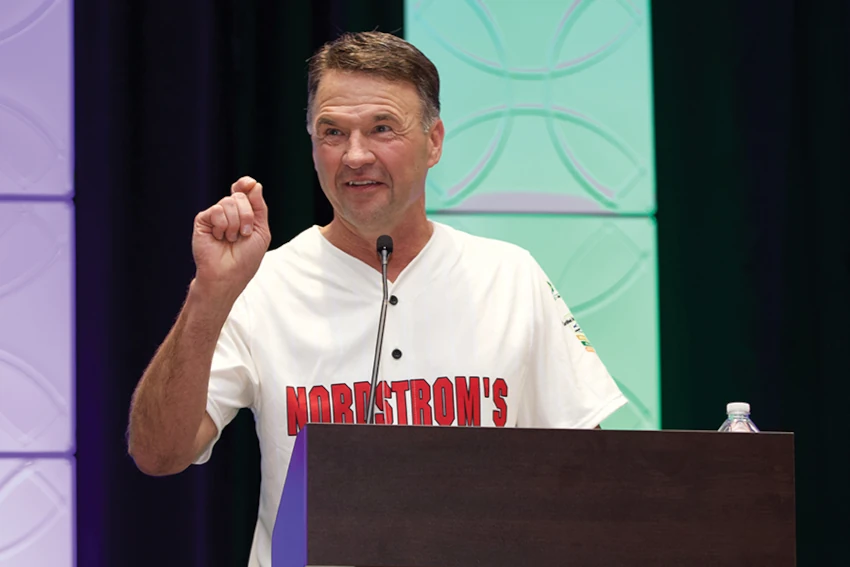
Incoming President Shannon Nordstrom is motivated by people, processes, and positivity, and he takes his commitment to them seriously.

Caryn Smith
We learned a lot, we’re not afraid to ask questions. We are ambitious people, and going through the CAR process put us in the right position to be ready for what lay ahead.
Shannon Nordstrom took the gavel at the recent 82nd Annual ARA Convention & Expo in Birmingham, Alabama, in the presence of industry friends and family. For the first time, his parents, Art and Marie Nordstrom, the first-generation at Nordstrom’s Automotive Inc., attended the annual event, joining his wife, Tamie, and their three children Riley, Madisen and Ava, along with their spouses. Also attending was a contingent of key employees from Nordstrom’s. “This milestone is a big source of pride for our family and our business towards my new role as ARA president, and my service to the industry,” he notes. So much so that he sought their approval to join the ARA Executive Committee, knowing the commitment would take time away from family and business.
“The first person I asked before accepting was my wife, Tamie” he shared. “It was important to have my family’s support, and my wife has been extremely supportive. She knows how passionate I am about what I do, and she knows the good relationships I’ve built in our industry. I can easily say that some of my best friends in life are people I see in our industry.”
“The second was my management team, which was just as important,” he continues. “I shared with the team that I’ve been asked several times, but I thought the time was right to do it now. They agreed. I couldn’t be doing this without the support of my family and my management team. I asked for their permission, and I think by the time I’m done, I will have stretched that grace.”
Automotive Recycling magazine spoke to Shannon about his company’s growth, the impact of ARA’s certification program on their success, the new ARA quality assurance program, ARA’s carbon study, high-voltage vehicle protocols, and more.
Automotive Recycling Magazine: You have championed the ARA Certification Committee for over 20 years. Why was this the right time to increase participation to join the ARA Executive Committee (EC), culminating now in your year as President?
Shannon Nordstrom: I am at a point in my career where I’ve learned a lot, and I can give back to the industry in a way that is more complete. You always try to find the best time when this service commitment aligns with your personal life, because your personal life is also cherished. Sometimes, you’ve just got to do it.
I have a better handle on industry knowledge than I did when it was first considered years ago. We have taken what we’ve learned from the industry and done well with it. I can more deeply relate to folks in the industry now and provide better advice or guidance. I never wanted to be hypocritical; I want to provide any guidance I offer from a position of experience and perspective.
We started our improvements at Nordstrom’s Automotive Inc. with the ARA Certification Program (CAR), and that’s why I’m so passionate about it. My parents, Tamie, and I, working alongside our dynamic team, have transformed our small recycling junkyard built within the family dairy farm, in the middle of nowhere, into one of the more advanced facilities in the country. We utilized our relationships with ARA peers and mentors, as well as the knowledge gained from the events. I did not do all this without ARA, and I respect that, and I want to pay it forward.
ARM: What inspired you to be certified and drive your innovative facility improvements?
Nordstrom: We were certified in 1999 after learning about it at our first ARA convention in Denver. Then, in 2012, we had a facility fire that was not catastrophic, but it destroyed one of our bays. It was then that we started thinking seriously about building projects, along with considerations about the transition of the family business. I had thoughts – independent of my parents – about how I wanted to move forward, and they were at a point in their lives when they weren’t as willing to take risks. That’s when we accelerated the transition of the business to my wife and me.
I wanted to dig in deeper and was willing to borrow funds to provide the best chance of sustainable success over the next 50 years. The facility fire really ignited a desire for growth and improved facilities for safety and the comfort of employees.
I didn’t realize at the time, but looking back, this effort was my 10x move. I went way beyond my comfort zone, knowing and trusting in myself and the people around me that we could figure it out.
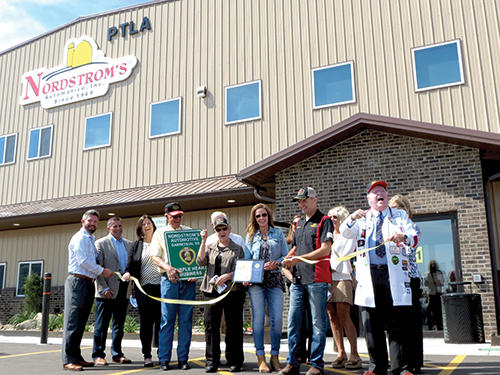
At the time of the fire, we probably had about 50 employees. Now, we have 80 who are all actively involved in different operations, so significant growth since we built the new facility, which was dedicated with a ribbon cutting in 2018.
Growth ideas also came from organizations within the industry where I network. My work with ARA allowed me to get to know and connect with member recyclers. Team PRP has been a driving force behind the most recent significant business growth. Now, we move our parts around the country.
ARM: eBay's requirement for CAR certification to sell airbags on the platform brought new members into the program. Is it becoming more relevant to be certified for auto recyclers? Would outside forces require industry businesses to be certified?
Nordstrom: First, one of my initiatives during my last two years on the EC is to continue educating on the value of certification, even if only for what it did for our company, and to make it accessible to people.
I have been so passionate about this because back in the day, I only knew what I knew. Discovering the ARA CAR Program was truly our roadmap for building our 2.0 auto recycling facility. It highlighted the things we needed to pay attention to.
We learned a lot, we’re not afraid to ask questions. We are ambitious people, and going through the CAR process put us in the right position to be ready for what was in front of us. I have benefited from that value time and again, and I want to get other people interested in that aspect of being CAR.
I truly believe that there will continue to be opportunities that require certification if you want to be involved with it. If you look at the auto collision industry and all these other industries, they have certified programs. To be at the top level, you’ve got to be in those programs.
We will continue to see vendors requiring or rewarding certifications, such as insurance companies or regulators tied to the processing of end-of-life electric vehicles. At some point, the industry will want to work with those who are trained and equipped to handle EVs correctly, and all vehicles, for that matter.
The environmental responsibilities of corporations will further drive companies to seek environmentally conscious auto recyclers that can measure their impact – such as our contribution to carbon emissions. It would be forward-thinking to not only deliver a customer parts statement, but also a carbon footprint statement detailing the carbon savings you provided by buying your recycled product.
There are already industry leaders in these areas, whom I want to thank. Car-Part has really taken the lead, and Solera is looking to be more involved in carbon data tracking. We will see continued movement in that area. At some point in the future, manufacturers will be dealing with producer responsibility (EPR) requirements, already in place in parts of Europe. They will need certified companies to work with them.
ARM: Please share about the quality assurance effort between ARA and URG.
Nordstrom: ARA and URG are working together on a quality assurance program to improve upon the retiring ARA Gold Seal Program. Before the convention, we had our first marketing meeting for the new program. It’s not officially named yet. The CAR Program signifies that a facility has its brick-and-mortar in order, including approaches to environmental responsibility, safety, curbside appeal, licensing, insurance, etc.
This new, improved program is merging the best of the ARA Gold Seal Program, URG’s standards, and ISO 7000/8000/9000 quality programs. In fact, Pat Huesers from PAM's Auto did an excellent job recently of sharing the ISO advantages with the committee. We are now prototyping and seeking our first members to walk through it with us. It is going to open doors when it is released.
We already have vendor-level interest in this program when it is ready for our members to join. There is a high demand for auto recyclers who are qualified at the highest levels of integrity and quality, which is at the core of this program.
I’m excited to take it to the next level, and with the combined efforts of ARA and URG we will make sure to include all the right elements. The vision for the program is to stay ahead of potential trouble spots that could impede our members’ businesses. I am thankful to Sue Schauls, consultant to ARA, for her knowledge, ideas, and direction for the certification programs. She does a great job of combining all the information into systematic applications that are easy to digest.
Early on in my participation, I worked with Dave Kendziorski when he was active with ARA. He hammered home the idea of a ladder approach to ensure a smooth entry into the certification programs, and then they can grow their level of compliance over time. That is why we have a baseline percentage threshold for certification, along with benchmarks for expected compliance targets.
Furthermore, with Sue’s guidance, we added Compliance Checkpoint – an industry-scale software solution for organizations that want to build compliance integrity – to track progress and manage compliance electronically. That was a big deal.
We have also included invaluable tools for recyclers with their ‘electronic record’ in Compliance Checkpoint, such as quick links to ARA University.
I’m really excited about taking certification to the next level with the new quality assurance program, which will include business benchmarking and more for those want to take things to the next level and have true accountability for delivering a quality product and experience
ARM: Can you share about the ARA Industry Relations Committee you also chair?
Nordstrom: The Industry Relations Committee is establishing relationships with the short-term goal of building upon for the long-term benefit of both sides. We want the auctions to develop a deeper understanding of the habits of professional auto recyclers, their buying practices, and the processes we go through on a daily, weekly, and monthly basis. We are seeking better ways to benefit more from buying being efficient, effective, and fair. We also want to understand why they do the things they do, and we have learned much already. We will be passing this information to members as appropriate.
ARA has had some very good conversations with the large auction consolidators, yet it is very challenging. They’re very large companies, and we represent just a small fraction of their business. We do influence as a collective, but the exports and purchasing of other customer groups may exceed our impact on their bottom line it seems.
We learned a lot, we’re not afraid to ask questions. We are ambitious people, and going through the CAR process put us in the right position to be ready for what lay ahead.
My goal is to continue high-level conversations that tell our story of the professional automotive salvage buyer, cultivating appreciation for the consistent business they bring to the table. And even though we might not have as many zeros behind our numbers as others, we are constantly working within their platforms.
I feel very good about the progress we’ve made with Insurance Auto Auctions (IAA). Natalie Warner Rasmussen has been very helpful in organizing our conversations and has gotten us an audience with IAA higher-ups, and we’ve also had discussions with Copart. We just haven’t gotten as far there. We will continue to knock on those doors and try to have high-level conversations. We appreciate their support of our industry. They have often been generous ARA sponsors. It is our goal to build long term relationships that add understanding that benefits both parties.
ARM: What is your focus for this year?
Nordstrom: I always want to focus on certification, yet even more so, I want to make sure that every ARA member has an opportunity to be part of the Association process. Coming from such humble roots, and still feeling like a humble company, I want to make sure everybody knows that they can be involved, no matter the size or volume. Sometimes people perceive it as a good-ole-boys club, but it’s more of a family. I really want recyclers to know that they’re welcome, there’s plenty of room, and we need their involvement.
The EC members agree. We truly appreciate all our members and thank them for their involvement in the advocacy work being done on their behalf.
ARA needs horsepower, and a lot of that horsepower comes from the grassroots – our independent operators. It also comes from the people who have, at some point in their work life, established a relationship with their congressional representatives through business or personal dealings. Those connections are valuable to our Association.
ARM: What are some specific items ARA is working on this year?
Nordstrom: There is so much going on, I have so many notes. ARA continues to promote and advance the Worcester Polytechnic Institute (WPI) Carbon Study done with ARA, which proved our industry’s carbon savings. The findings were released in April, which proved that using recycled auto parts significantly reduced harmful emissions compared to using newly manufactured parts.
We are also focused on enhancing our resources, such as the new a-r-a.org website. ARA University training videos are being reviewed through ARTI and ARA to make sure that we have the best methods in place to keep training content fresh.
I believe that the environment is ripe for an opportunity to change the rulemaking to enable us to reuse catalytic converters. I’ve been pressing on that one already. I think the political winds present an opportunity to alter the interpretation of the current regulation. The goal is to be able to self-test and self-certify converters from our vehicles. We would have the option of selling them for reuse, and the option, if there’s no demand, to sell them for the precious metals that are in them.
ARA is positioning our industry for the future of high-voltage vehicles. I want to ensure that our members know we can provide the resources, both internally and outside the ARA, to provide avenues for processing and disposing of these batteries in a timely manner. We don't want recyclers to be forced to hang onto them for lack of resources. There is a real fire safety risk if batteries are not managed properly.
I’m excited about the collaboration between Argonne National Labs and ARA currently in progress. This program will be one of the first in the automotive industry and will take EV handling it to another level. It’s a big initiative. The end result of the ARA/ANL collaboration is a very robust, updated, high-voltage vehicle dismantling protocol.
ARA plans to break the updated protocol information into two different segments: a full view of the business approach, and then handling the high-voltage vehicles at your facility. Many recyclers say, ‘we don’t deal with those,’ yet they’re starting to come into facilities unknowingly. When you buy 50 vehicles from a tow lot, one of 50 is likely to be high-voltage, and you will have an old Kia or Honda with a high-voltage system. You must then deal with it safely.
Also, a goal would be to have training for company roles such as, general employees, lift operators, warehouse, delivery drivers, and the dispatchers who bring in vehicles. This provides everyone in a facility a level of safety awareness and knowledge, which is important. An in-depth training is essential for dismantlers who handle the batteries.
ARM: As a proud family business operator, how do you see the business going for the next generation?
Nordstrom: There are many great young members getting involved. We see them at ARA’s convention, URG meetings, and regional/state meetings. They have such different ways of doing things. Their eagerness to grab a computer or a phone and just figure something out quickly using YouTube is impressive. They don’t have many stumbling blocks – they’ll dig in and figure it out one way or the other, with a lot of resources at their disposal. Access to information could even bring a continued renaissance to the do-it-yourselfer, opening new opportunities for our auto parts.
I think the technology push from younger people in the industry will overcome industry deterrents and create opportunities to enable the next generation to thrive.
My son Riley has joined our business now. With three generations working on the property, it is pretty freaking awesome and a source of pride. We have him working in every department for extended periods – he’s going to learn everything. I want him to know how each one works inside and out. Then he’ll prepare us for ARA’s new quality assurance standard when it is released. Also, I’d like to follow in PAM’s Auto’s footsteps and get ISO certification. He will be working to obtain these certifications.
He has also created an intelligent agent to search and gather the data scattered across our various computers and workstations that we need to make the next version of our training manual. He is also doing some graphic design and videos for us.
On technology, in my opinion, AI is not going to replace our employees, but the people that know how to use AI in our industry are going to accelerate the workplace. My son and his generation learned how to do things differently and will bring a lot of value to our business.
ARM: What are your thoughts on vehicles and data privacy impacting the industry?
Nordstrom: It is a concern. While attending the CARS conference in England – the first time I have attended – we toured two different facilities. One had a very strict policy that they didn’t allow me to take pictures if it involved a stock number or anything that can be traced back to where a car might have come from. They must also remove all personal data from the vehicle before they sell it, resetting all the telematics to basically factory settings.
European manufacturers must comply with data protection laws like the UK GDPR and the Data (Use and Access) Act 2025. These regulations require car manufacturers to implement mechanisms for users to access, correct, or delete their personal data. We are going to see more of that.
ARM: Is there anything else you would like to address?
Nordstrom: The work we are doing as part of the ARA EC is vital for our industry. I don’t take that lightly.
God has blessed our family business with opportunities, and we’ve made the most of them, but not on our own. We’ve done it with faith, and with a lot of people that I’ve probably pestered over the years, asking a million questions. Those same people were more than willing to mentor me in the industry because they knew I was pretty fired up about doing well.
I owe a lot to ARA's past president, Harry Haluptzok from John’s Auto Parts. He was a mentor of mine. Our son, Riley, took the youngest yard tour ever, as he was a few months old when we went through John’s Auto. Greg Freeman, who had led the Certification Committee before me, saw that I was really interested and took me under his wing. Jerry Anderson from AAA Auto Parts, and his family, we have built a relationship over the years.
My VRG (Vehicle Recyclers Group) partners have been so supportive, too. We formed a group that includes the family businesses at Schram Auto Parts, Stricker Auto Parts, G&R Auto Parts, and Spalding Auto Parts. All are great, independently owned, high-level certified auto recyclers. Within that group, we all have the ‘iron sharpened iron’ mentality.
Bringing it back to certification, the VRG was formed to take on distressed vehicles for an auto manufacturer. Nordstrom’s has been a part of it since 1999. These manufacturers trust us because we do what we say we’re going to do. Joining that group was only possible for me, especially because I was on the ARA Certified Auto Recyclers list in 1999 when they were looking for someone to help them in the Midwest, and that list was very small. That’s the only way I got into that group.
Also, from my dearest friend, DJ Harrington, I adopted the CANI (Constant and Never-Ending Improvement) mindset that he preaches. I’m a prodigy, like a son he has told me, and I sat in so many of his classes.
I take seriously the pulpit that I have. I call it the pulpit because I have an opportunity to influence people positively, whether that be a faith-based way a business-based way, or a positive-perspective way just to keep pressing on. I want to make the most of my opportunity to influence the industry. I really enjoy people, especially those in the industry.

Caryn Smith is the editor of Automotive Recycling magazine and Automotive Recycling ToolBox Edition. She has been covering the industry for 25+ years. As a freelance writer, she is a contributor for other industry publications, such as Recycling Today, International Filtration News and International Fiber Journal, among others.