By: Jer Banta

Assume that they want to buy your part. Let’s see how serious they are right out of the box. “IF we can find the part you are looking for that fits your needs, HOW SOON are you looking to get this done?”
Clients often hire me to work with their sales teams to improve performance and profitability and provide guidance on best practices. I have worked with hundreds of individuals and hosted many sales training classes and seminars over the 30+ years of my career as a sales manager and consultant. Through much trial and error, I have come to realize that the success of the salesperson starts with ME (and YOU) as their coach and leader. We must always look in the mirror first before we cast blame on our team for under-performance.
With that being said, most of us in this industry have not had the benefit of formal training on “how” to coach, lead, or train our teams, and there’s a good chance that we may have been high-performing salespeople who got “promoted” into being the manager. Sound familiar? Some of us are naturally good at these things, and some of us need some help (like I did). If you are not naturally blessed with great coaching and teaching skills, I strongly suggest looking into training and coaching to help you navigate the ups and downs of leading a team as you embark on the journey of leadership/management.
Okay, on to the meat and potatoes.
Let’s start with the common term/name that we throw around when we call our teams “a bunch of overpaid order takers.” I have witnessed this “behavior” and have heard a million phone calls where the salesperson answered the phone, said, “yeah we got it,” and they got the sale with very minimal effort or “selling” happening on the call. The blessing in our industry is that we have a product people need and will buy it a certain percentage of the time regardless of how well we “sell” it. This has led to many bad habits and “order taking” from our salespeople. The question I ask is, “Who taught them that behavior?”
Training!
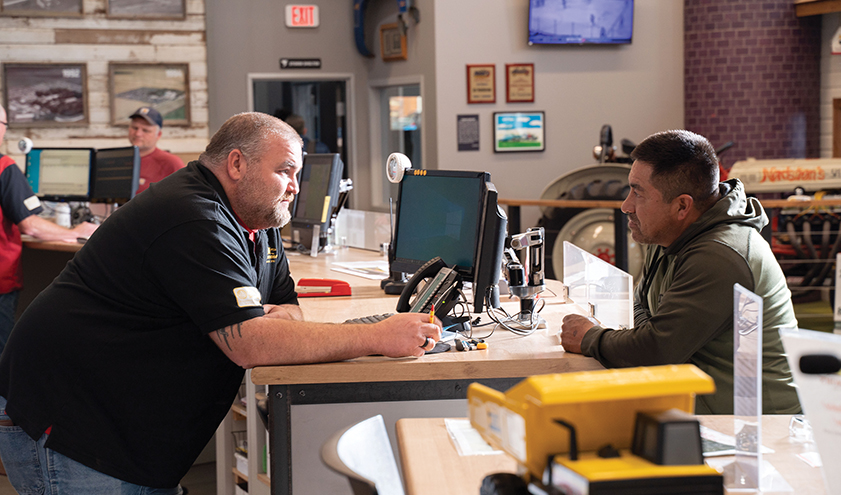
In general, we do a pretty decent job teaching folks how to use the tools of our trade. We spend lots of time teaching them how to navigate our YMS, the third-party bolt-on programs, and all the processes/procedures that we do in a day, so they understand “how” to physically sell a part and what to expect when they push the buttons, right? I remember my “training.” It went like this: “Here’s how you look up a part, here’s how you write an order, here’s how the phone works, now answer the phone and tell ‘em ‘WE GOT IT!’”
Granted, 30+ years ago times were a little simpler, yet that training mentality still exists in many places today. Obviously, we need to teach folks how to work with the tools. We also need to focus on the WHY we do what we do, and how our industry truly fits into the parts supply chain. That’s where WE come in as their coach.
How do we break the age-old thought process of ‘it's my job to answer the phone, look up parts, and give prices'? 2 major things are working against us in this mindset shift: US and Our Training. The more difficult part of the equation is that our customers expect us to look up parts and provide prices. So, not only do we need to train our salespeople to be better sales pros and qualifiers, but we also must train the customer to accept that we’re going to be more than an information desk. ‘Okay Jer, how do we do it?’
Understanding!
There is a reason this business can be hard to teach and truly understand. Why? Every single part we sell is absolutely unique. We are not stamping out widgets on an assembly line. On top of that, every customer we speak with has a different NEED or circumstance surrounding the part they are asking us to supply. And then add the components of our B2B relationships. We are selling to a customer that has a customer, and we need to not only satisfy our customer’s needs, but also magically draw out what their customer may want to buy and why they want to buy it.
This is starting to sound like a lot of work and effort … no wonder we don’t train our people on this skill. It’s hard enough to understand it ourselves! We need to spend time teaching and coaching our people on WHY our customers buy parts and the differences between Retail, Mechanics, Dealerships, Collision, Rebuilders, Exporters, etc.
Luckily for you, I have made a million mistakes and tried a million different ways to sell auto parts, and a million ways to teach people to sell auto parts.
I have been blessed to have worked with some great salespeople and coaches over the years who have been influential and have helped me develop a simpler way to understand and teach an improved sales process.
Process!
Here is how to create clarity and a process to help our order-takers become Sales–Pros. The premise of what I teach is based on gathering information to provide a solution that fits the unique need of the unique customer rather than just giving information when a customer asks for a part.
It all starts with the WHO. If our customer does not introduce themselves at the beginning of the call, we must slow them down and ask BEFORE we get distracted by the part. “I’m sorry, I missed your name, and is this for your vehicle or do you have a shop?” SIMPLE, effective, and puts the salesperson back in the driver’s seat because WE are asking the questions.
Then, what do they KNOW? Our customers are more informed (correctly or incorrectly) than they have ever been. The power of online searching and auto-filled estimates with prices, quality, and availability is higher than ever, and it’s NOT going to stop. The next thing our folks need to ask about is “what” the customer has found so far, and do they have any point of reference on used or new parts? They can use a conversational question like, “Great, let me get you fixed up; did you find us online today, or have you gotten any other used or new prices?” I need to know what they know. ASK and LISTEN. Now, the salesperson can plan their qualifying based on what they hear; NOT on what they assume. They need to be listening to the story: WHY the customer called and what is most important to THEM.
Determining the DETAILS. From this point, we can address and qualify for the four main reasons folks decide what part fits THEIR needs best.
1) The TIME/Availability
2) The QUALITY
3) The WARRANTY
4) LASTLY, the PRICE.
Time, quality, and warranty determine the price. If our folks don’t understand the customer’s wants and needs on the first three, we cannot accurately give pricing on the product. Remember, every part we have available is unique.
Qualifying Time FIRST. I love IF questions. Assume that they want to buy your part. They called you for it; they have a problem. Let’s test the water to see how serious they are right out of the box. Ask them: “IF we can find the part you are looking for that fits your needs, HOW SOON are you looking to get this done?” OR “IF we still have the part you found online, are you ready to order it today?” OR “IF we have the part available, will you need this delivered, or would you like to pick it up at our location?” OR “IF we have what you need, how soon are you bringing the vehicle in the shop?”
ASK AND LISTEN! The customer will likely tell you, one way or another, that they are just gathering pricing and availability (quoting only) or that they are ready and have it sold (a sale) if you can come up with the solution that fits THEIR needs.
Present Quality as a question, not a statement. Many of our customers tell us right away what they are expecting from a quality standpoint … miles, condition, color, etc. If they come out and say what they want, ask for the sale (before pricing). “If we can get one under 120K, is your customer ready to schedule the job?” If they don’t know and want to “see what you have”, give them a “this or that” option (when available). “We have one available with 79K or one with 127K, which one sounds better to you?” OR “We have an insurance-quality door available or a nice door that needs a little repair that we can offer repair time on; which one fits your needs?” When we ask them to agree or disagree, THEY are picking what is important to them. Quality helps determine value and price.
Assume they want extended warranty and labor protection (If you offer it).
Start with your best warranty with a suggestive question. “You want the pricing with our two-year parts and labor coverage, right?” (It’s important to note that the salesperson should not have given any “base” pricing at this point in the conversation). I only want to talk about my base warranty IF they object to extended coverage or labor protection. When I start with the best warranty, I have lots of wiggle room to adjust the price down by taking away coverage, only if they object to the price.
THE PRICE. Finally, we are ready to deliver what this unique part and solution is going to cost. We know WHO we are talking to, we’ve asked what they know, we’ve asked WHEN they need it, we’ve qualified for the quality they WANT to buy, and we have offered and asked to quote our best warranty solution for their NEED.
Get Specific!
REPEAT all the cool stuff we just talked about back to the customer, present the price, and MOST IMPORTANTLY, ASK FOR THE SALE OR OBJECTION.
“We have the 102k engine, with the two-year part warranty and $1,500 of labor protection, delivered to your door for ONLY $2,500 plus the core, HOW DOES THAT SOUND?” They must shut up and LISTEN at this point. I want to hear, “Yeah, that sounds perfect!”
OR “Oh, shoot, I didn’t think it would be that much.” EITHER is OK, and now I can either focus on closing the sale OR re-asking questions to overcome the objection.
“Okay, I understand that’s a lot of money. What were you thinking?”
OR “If that doesn’t work, what’s most important to you: the miles, the time, the warranty, or the price?” Then, LISTEN. We can now update the details to meet their needs. Sometimes they want better quality, need the part faster, or want a longer warranty.
How can I pull the levers to make it happen?
All these things have costs that can go UP or DOWN … be flexible and accommodating. If you didn’t hit all the needs the first time, go back and fix it, adjusting as necessary based on what they say.
Sales is an Interview
To sum this up, and if we want to build better sales pros, WE need to help them understand and teach them the importance of asking questions to find the proper solution for the unique problem our customer has. Building high performers requires investing significant time and effort to help them hone their skills and offering outside training opportunities when appropriate, such as when you don’t have the time or skill to provide it.

Jer Banta is a seasoned auto parts industry leader with over three decades of experience, having progressed from an entry-level delivery driver to senior leadership and consulting roles. His career spans privately held companies and consolidators, with notable achievements including building and scaling a dismantling facility in Northeast Ohio and helping position a company for acquisition. Currently with PTC, Jer leverages deep operational expertise, KPI-driven insight, and a strong passion for people and culture to help recyclers improve performance and develop high-performing teams across North America and beyond.