By: Brian Bachand

I know we want to sell every part, and if we could, we would have one of everything and more in stock at all times. This perception, however, is regrettably flawed. … “Do not fall in love with the box.”
“The Gambler” by Kenny Rogers may not be in my top 10 songs on my Crushing Cars Playlist, but it is pretty well known. I will go out on a limb and say it is a good song, given the grassroots of the automotive industry. Kenny’s ballad harmonizes the reasons and tactics a gambling man learns and bestows upon the narrator about the game of poker and, subsequently, life itself. However, if you really listen to the lyrics, the parallels one can draw from the principles in the song and the logistics of car crushing are uncanny. Yet what drives us to crush cars, the how and the when, is based on a few principles that every operator seeks to define within their own scale and operation. So really in this case, as the song sings, “You got to know when to hold them, know when you fold them, know when to walk away, and know when to run.”
How do we know when it is time to crush cars and when it is not?
For some, this is a no-brainer. When the scrap market is up, we begin to think about crushing; when it is down, we “walk away” or deprioritize this side of the business. When prices are really up, we begin to “run,” crushing above previous numbers so that we are capitalizing on this favorable market swing. These scenarios are major drivers that influence when to crush. However, there is more to the decision besides Net Ton Price that determines our crushing endeavors. Depending on who you sell your crushed cars to, this commodity is usually quite a liquid asset. We send out flats, and we are usually paid for the load within two weeks at most; sometimes the same or next day.
Barring any deductions, freight, fuel surcharge, or environmental or handling fees, what you send out is what you are paid for. Unless you are in noncompliance, loads are accepted, and we are onto the next load. This transaction is unlike our ROE™ quality used parts sales, where there is always the risk of return, warranty, or a buyer changing their mind. These benefits alone of crushing cars for some operations are enough to fast-track this process right to the top of our priorities list. If you need quick capital, this is an excellent revenue stream to tap into. So what else motivates us to send out servings of these proverbial pancakes?
How many operations out there have unlimited space or have operations that are so efficient in the life cycle of their end-of-life vehicles that the demand for parts exceeds the demand for continuous reinvestment? I know we want to sell every part, and if we could, we would have one of everything and more in stock at all times. This perception, however, is regrettably flawed. As Profit Team Consultant Rob Rainwater has continued to impress on the industry, “Do not fall in love with the box.”
Every open space for an inventoried vehicle in your yard or spot on your shelf or rack for an inventoried part is rented real estate. This space is valuable, and the longer we rent it out instead of selling and replacing it in the prompt and proper time frame, the more money it costs us. Vehicle and parts turnover is crucial to keeping our inventory up to date, preserved, and relevant. We are not running museums; we are facilitators that gate keep where and when our parts, cores, and vehicles go. To prevent overcrowding or compromising our inventory, storage, and operations, it is essential to maintain a crushing schedule that supports your logistics and your bottom line.
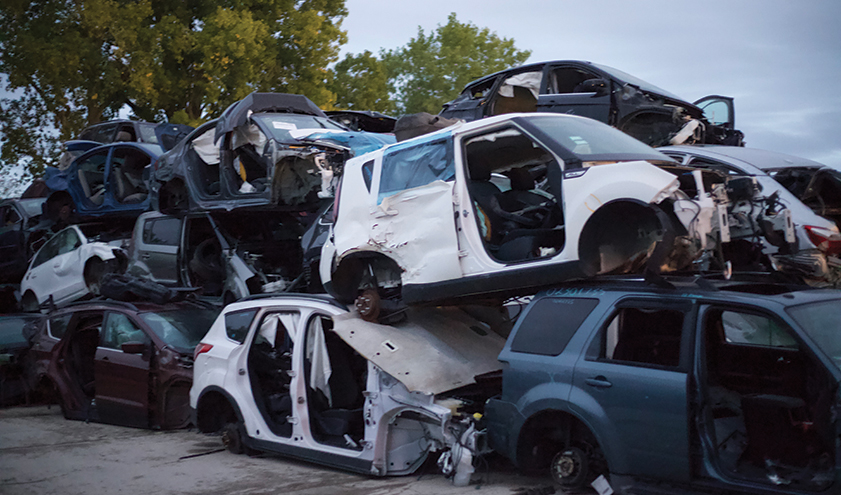
So as we navigate ‘when to hold ‘em and when to flatten ‘em,’ what does the prep and process look like for crushing? Before we can answer that, I think it is important to ask a few qualifying questions and understand some common limitations. First, do you own your own crusher?
If you do, well then, hypothetically, you are the decider of your own fate. If you do not, then who do you contact to crush? How long before Crusher Bob shows up, and what goes into the preparation of the crusher’s arrival and into the ramifications of its aftermath?
And to the big question, what is the total cost to source the actual crushing job?
These are moving and variable factors that play significant roles in when and how you crush. When this process has to be sourced out, the importance of preparation, planning, and time management is essential to cashing in on market swings and accomplishing the independent goals we all may have. When the control is within your walls, there are fewer variables and the process can be quicker and potentially more proficient. This further allows you to decide how to implement and what you want to get out of your crushing program.
When we determine that the time is right to get a load together to crush, what goes into the culling of the vehicles destined for the press? We all do the same thing, just differently. So these parameters that influence your decision may not have a one-size-fits-all directive. Maybe you have space for a designated “crush area” where you can move vehicles to. Perhaps you make a spot when it is time to crush. Either way, the best practice is to continue to keep this holding, storing, and crushing area or areas as clean as possible.
Embrace the CAR Certification and embody it through these environmentally compliant and safe practices. Ones that will put money in your pockets as well. But we will touch on that in a little bit. The key here is optimizing your space so that workflow and operations are not hindered or unhinged through this process. The life cycle wheel needs to keep turning, and that is in all aspects of our operations.
So the next big question to be asked is what vehicles are you crushing?
Do you follow the reports and see what vehicles have done what, for revenue in the first 30 days, 1-3, 3-6, and 6-9 months? Are you simply pulling the oldest from inventory, or is it a hybrid mix? If you have ever loaded a trailer of flats, it is not as simple as pulling out 15-24 vehicles, crushing them, and expecting them all to fit on the trailer. Especially the way in which you might have envisioned they would. There is a science to this; it is adult Tetris, and when done right, it is an art form.
The sight of a full trailer with 20-plus crushed vehicles on it, right to the top and jammed full, is a great feeling. Maybe not as nice as seeing the check for it when the market is high, but still a success. However, unless you are buying from the same flats buyer or hauling your own flats, we are still subject to different trailer sizes and dimensions. Not to mention different haulers are rated for different weights and may only take what they are willing to take. So sometimes we crush X amount of vehicles yet only send out what they are willing to take.
That means we have to sit on material, and unless the market is rising (which lately is not the case), then this may not to be the most beneficial leftover material to be sitting on.
You have condemned the vehicles destined to become pancakes and have pulled them aside, so now what?
Are these vehicles dismantled during your process period, meaning you are harvesting viable and valuable parts to be stored and coring out the commodities at the intake time? Or are you sending help out there to penny-pinch the rest of the vehicle? What I mean by this is: are you spending time prepping the vehicle before it is crushed, or have you made this step a part of your earlier process in the vehicle’s life cycle within your operations? A lot of these questions you have to ask yourself to see if the juice is worth the squeeze. Do you have room on your shelves to save parts from these vehicles?
In contrast, if they have not sold by now, why is that, and why would we continue to hold on to it? Do you have the workforce to employ a team member or crew to strip these vehicles of any commodities you want to be paid separately for? Are you pulling the drivetrain before they are flattened or leaving it for weight? And do the extra cores and metal not add up to the time and money you would have to spend to get them off? There is no way to count cards on this one; wherever you see your resources optimized and your time best spent is how you should proceed. Yet keep in mind, there are additional revenue streams if you adjust your expectations and operations depending on whether that is the hand you want to play.
Throughout the industry, recyclers are constantly looking for new and additional revenue streams. Penny-pinching vehicles is a realistic avenue to generate previously missed revenue from your vehicles. Clean raw material copper is averaging over $6.25 a pound. Supply constraints and increased demand have the scrap copper market on the rise. Bottom line, it would be wise to start harvesting wire from your crushed vehicles before they are flat. Piling harnesses and cables in a Gaylord box adds up quickly, and there are no worries about it coming back. Same with alloy wheels. You may be leaving steel wheels on the vehicle, but when core alloy wheels have an average value of $20 per, generally speaking, then it should be a no-brainer to pull these off.
If you use the vehicle as storage or the car is partially dismantled, it may be smart to grab what is off in the car or easy to harvest. Core accessories like Alternators, Starters, A/C compressors, etc. add up whether they are good enough to be rebuilt or scrap. Same goes for loose or easy-to-access #1 steel or aluminum, such as axle shafts, drive shafts, aluminum intake manifolds, and rebars. It is up to you to decide how to leverage what is left of these crush cars. As Rogers sings, “The secret to survivin’ is knowing what to throw away and knowin’ what to keep.”
Lastly, there are a few more ways to add value to your crush cars.
One of those is tires. Certain buyers will take four or five tires in total on and inside each of these vehicles. You can choose to capitalize on this by strategically placing the accepted amount in each vehicle and saving the expense of paying to get rid of them. If time allows, steel wheels are #1 steel that can be cashed in or made into stands for your inventoried vehicles. You can take those off and separate them accordingly, and place the tires back into the vehicle. Another idea is to start thinking again about the auto shredder residue (ASR).
At some point in the near future, our industry in the United States will transition to do more automotive plastics recycling. California Bill SB811 looks to tighten regulations on the shredder and, subsequently, the crushing processes by appointing the DTSC (Department of Toxic Substances Control) as the head regulatory party.
Currently, ASR is not considered hazardous waste, and given this classification, recyclers can leverage this until automotive plastics recycling logistics and infrastructure are mapped. This has the potential for us to use crushed vehicles as stuffers. You can open the roof on a vehicle as a tin can top, or however you see fit to prep it and proceed to clean your yard of loose and scrap automotive parts and debris. Just be aware of what you can and cannot put in a crushed vehicle, and always make sure that fluids, vehicle batteries (especially all high-voltage batteries), and any hazardous materials are removed during your prep process.
Crushing cars is an integral part of what we do as auto recyclers.
Optimizing this process is just as important as inventorying, depolluting, and dismantling the vehicle. We want to make sure we are compliant and implementing environmentally friendly processes, but also cost- and time-efficient in our pursuit to squeeze the remaining profit from these end-of-life vehicles. More than ever, we are focused on margins. Making a plan and getting the most out of your flats before transport is a sure bet to make up for some of our losses or returns. By optimizing transport logistics and strategically timing commodity cycles to secure peak pricing, you can minimize overhead while maximizing the yield on the final stage of your end-of-life vehicles. The direct result of this coordinated approach is a highly efficient operation and a healthier bottom line.
With the right mix of time, yard space, and resources, you can strategically leverage your surplus inventory for maximum downstream profit. For some, it makes sense from time to time to sit on material, like stockpiling catalytic converters, to store flats or have leftover crusher bait on hand and then cash in when the commodity market peaks. For others, the immediate liquidity of crushing is the smarter play, securing the near-term cash flow needed for reinvestment.
Whichever path you choose, your crushing program is a critical spoke in the operational wheel; it requires consistent management to keep the entire business rolling. While your logistical goals will always be unique to your yard, there are universal principles that can make any crushing program more efficient and profitable. Don’t hesitate to connect with fellow recyclers, ARA members, and staff to trade best management practices or exchange advice on how to maintain compliance and keep evolving.
So make a game plan and a good playlist and make it happen! Whether he’s on that playlist or not, as you now know, Kenny Rogers will tell ya, “You’ve got to know when to hold ’em, and know when to fold ’em,” and in our business, mastering how and when to flatten them is how you play a winning hand.

Brian Bachand is a second generation auto recycler, who helps own and operate Westover Auto Salvage in Belchertown, MA. He is on the Board of Directors for the Auto Recyclers Association of MA and a proud ARA Member. Brian has a Bachelor’s Degree in Accounting and paired with almost 25 years of auto recycling experience, will continue to implement ARA Advocacy for being a leader in the auto industry.