By Lisa Ryan, CSP

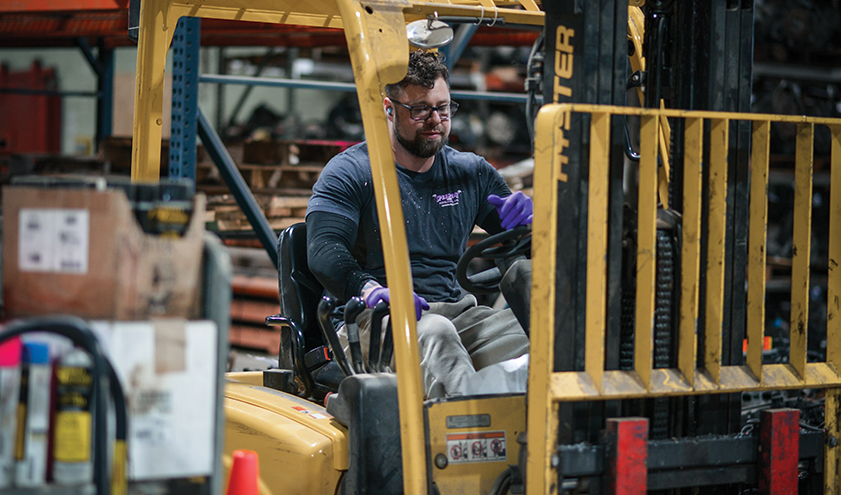
Walk through almost any automotive recycling facility and you’ll eventually hear some version of the same sentence: “Go ask Dave.” Dave knows which vehicles consistently hide damaged components that don’t show up until labor’s already been invested. Dave knows which inventory descriptions create problems downstream. Dave knows how to pull a part faster, spot a problem earlier, and avoid wasting three hours on something that was tagged wrong three weeks ago by someone who didn’t know better. Dave knows which newer models behave nothing like what the service manual suggests, because he’s pulled enough of them to have figured that out the hard way.
Dave also plans to retire someday. And that’s a problem most recyclers are already beginning to feel, even if they can’t quite name it yet.
Automotive recycling has never been simply about parts. It has always been about expertise. The ability to quickly evaluate a vehicle, identify reusable components, navigate increasingly complex systems, understand what the market will bear, and move material efficiently requires knowledge that typically takes years to accumulate. You can hire someone tomorrow and put them through every training module you have. They still won’t be Dave for a very long time, and both of you know it.
The industry is also changing faster than it ever has. Electric vehicles are entering salvage streams in larger numbers, bringing battery hazards, new disassembly requirements, and high-voltage systems that experienced dismantlers have never encountered before. A lithium-ion pack that looks undamaged can still carry serious risk. Thermal runaway doesn’t announce itself. The knowledge required to work safely around these vehicles is different in kind, not just degree, from what most veteran employees built their careers on.
At the same time, vehicle systems across the board are growing more complex with every model year. Inventory technology keeps evolving. Customers expect turnaround times that would have seemed unrealistic a decade ago. Artificial intelligence and automation are entering conversations across every industry, including this one, and the pressure to do more with the same workforce isn’t letting up.
Here’s what all of that adds up to: technology is moving faster than knowledge can transfer. And the dangerous thing about expertise loss is that it rarely announces itself. A senior dismantler retires. An experienced buyer moves on.
A parts specialist takes a better offer across town. Operations continue, so nobody rings an alarm. Then smaller things start happening. New employees need more supervision than expected. Inventory mistakes become a little more frequent. Vehicles stay in process longer. Customer frustrations start showing up more often, and managers start hearing phrases like “nobody showed me that” and “that’s how they told me to do it.”
Those aren’t the sounds of bad employees. They’re the sounds of missing knowledge.
The challenge is that most of the valuable knowledge in a recycling operation doesn’t live in a procedure manual or a training checklist. Experienced employees know which vehicles create recurring problems that aren’t obvious from the outside. They know which shortcuts save time and which ones create expensive mistakes three steps later. They know when something feels wrong even when the inventory data suggests everything is fine. They know which customers will accept a part graded a certain way and which ones will call back unhappy regardless. Ask them to explain how they know any of this, and many will give you the most frustrating answer possible: “You just learn.” Or, “I’ve seen it before.” That’s not evasion. It’s the honest truth about how deep expertise actually works, and it’s exactly what makes this problem so hard to solve through documentation alone.
My newest book, Smart Plant: Aligning AI, Automation, and People, explores this tension directly. Organizations across manufacturing and industrial sectors are becoming better at collecting information while simultaneously becoming more vulnerable to losing expertise.
Those are two different things and confusing them is where companies get into serious trouble.
Software can tell you what entered inventory. It cannot reliably tell you whether the information is correct or flag the subtle inconsistency that an experienced eye would catch in thirty seconds.
Systems can document procedures. They can’t replace the employee who walks past a vehicle and immediately knows something is off before anyone else has noticed. The data exists. The judgment doesn’t transfer automatically along with it.
The organizations getting ahead of this are becoming deliberate about protecting expertise before it walks out the door. They’re creating mentoring relationships earlier in a new hire’s tenure, not waiting until someone is already struggling six months in. They’re documenting unusual situations as they happen, not trying to reconstruct institutional knowledge after the fact when the person who holds it is already gone.
Some are recording conversations with experienced employees, structured less like formal interviews and more like working through real problems together, asking veterans to narrate their thinking on actual situations rather than describe their knowledge in the abstract. That distinction matters.
People who struggle to explain what they know can often show you exactly how they think when a real problem is sitting in front of them.
The questions worth asking now, before anyone gives notice, are more specific than most organizations make them. Not just “what do you know?,” but:
• What mistakes happen repeatedly in this yard, and what does experience teach you about why?
• What decisions require judgment that isn’t written down anywhere?
• What would a skilled employee do in a situation the manual doesn’t cover?
• What do new people consistently get wrong in their first year, and what’s the fastest way to help them get past it?
These conversations take time. They’re worth having anyway, because the alternative is trying to reverse-engineer expertise from outcomes after the person who held it is gone.
Automotive recyclers already understand preventive thinking. You inspect vehicles before problems become expensive surprises. You evaluate conditions before committing labor.
You protect physical inventory because replacement costs money and goodwill. Human expertise deserves the same logic applied to it, with the same seriousness and the same lead time.
The cost of losing decades of accumulated knowledge doesn’t appear immediately. It appears later, usually when customers are waiting on a part, or inventory records don’t match reality, or throughput has slowed and nobody can quite explain why, or the one person everyone depends on finally cleans out their locker.
The yard doesn’t change overnight when that happens. It changes gradually, in ways that are easy to attribute to something else, until one day the problems are hard to ignore and the person who would have fixed them isn’t there anymore.
The question isn’t whether knowledge is walking out of your facility. In this industry, at this moment, it almost certainly is. The question is whether you’re building the systems, the relationships, and the habits to capture enough of it before it does.

Lisa Ryan, CSP is the founder of Grategy® and the author of Smart Plant: Aligning AI, Automation, and People. She works with manufacturing, industrial, and skilled trades organizations on workforce retention, leadership development, and protecting critical operational knowledge.