How Proprietary AI Can Help Auto Recyclers Recover More Value

By: Vladimir Sainciuc
That changes the question from, “Can we sell parts from this vehicle?” to, “What is the total recoverable value of this vehicle after labor, storage, selling costs, material recovery, and time?”
Automotive recycling has always been built on practical judgment. Experienced buyers know which vehicles are worth chasing. Skilled dismantlers know which parts deserve careful removal. Warehouse teams know which inventory turns quickly and which items sit too long. Sales teams know when a listing needs a better title, clearer photos, or more accurate fitment information.
But as the industry becomes more complex, experience alone is being asked to carry too much.
Modern recyclers now work across insurance auctions, VIN data, OEM part catalogs, marketplace pricing, customer messages, warehouse constraints, EV and hybrid components, scrap-metal markets, environmental rules, and changing buyer expectations. Each part of the business produces information. The problem is that this information often stays inside separate workflows.
That is where proprietary AI-based algorithms can create real value for automotive recyclers.
The opportunity is not simply to automate tasks. The larger opportunity is to turn the recycling operation into a connected decision engine—one that helps owners, buyers, dismantlers, inventory teams, and eCommerce staff make better decisions earlier in the process.
The first decision happens before a vehicle is purchased.
For many yards, buying still depends on auction photos, damage assessment, historical instinct, and a rough estimate of parts value. Those inputs are still important, but they do not show the full recovery picture. A proprietary AI system can combine VIN decoding, trim-level data, historical sales, regional demand, marketplace velocity, warehouse capacity, return history, dis-mantling labor, and scrap-material value into a more complete purchasing view.
That changes the question from, “Can we sell parts from this vehicle?” to, “What is the total recoverable value of this vehicle after labor, storage, selling costs, material recovery, and time?”
Two vehicles may appear similar at auction. One may have a higher expected parts value but also carry slow-moving inventory, difficult shipping profiles, and high return risk. Another may have fewer premium parts but stronger material value, faster-moving components, and lower handling burden. A connected buying model can help identify that difference before capital is committed.
This is especially important as recyclers face higher labor costs and
more expensive warehouse space.
A part that looks valuable in a database is not always valuable to the business if it sits for years, takes up space, creates fitment confusion, or requires repeated customer support. Predictive buying is not about removing human judgment. It is about giving experienced buyers a clearer view of the full recovery economics.
The same logic applies when the vehicle reaches the yard.
Dismantling has traditionally been one of the most experience-driven parts of the operation. That will not change. The best technicians still understand damage, fasteners, component condition, and safe removal better than any software. But AI can support those technicians by organizing information before the first part is pulled.
A guided recovery workflow can rank parts by expected demand, projected margin, storage burden, material content, and removal complexity. It can also flag components that should be tested, photographed in a specific way, routed to a special handling area, or moved directly into a material stream. In this model, the dismantler is not replaced.
The dismantler is supported with a clearer work plan.
That support becomes more important as vehicles add electronics, sensors, aluminum structures, hybrid systems, and high-voltage components. Safe and profitable recovery increasingly depends on knowing not only what can be removed, but what should be removed, when it should be removed, and where it should go next.
This is also where material recovery becomes a strategic issue rather than a back-end scrap decision.
For years, reusable OEM parts and scrap metal were often managed as separate businesses. In reality, they are two outputs from the same asset. Every vehicle contains a mix of resale parts, cores, aluminum, copper, steel, electronics, plastics, glass, and, in some cases, battery-related value. A proprietary recovery algorithm can help determine whether the highest value is in parts resale, material separation, core recovery, battery reuse pathways, or a combination of all of them.
For EVs and hybrids, that mindset is critical. Batteries, drive motors, inverters, charging components, and rare-earth material streams require more planning than traditional end-of-life processing. The most successful operators will not wait until the end of the dismantling process to decide where value exists. They will identify recovery pathways before the vehicle is purchased and update those pathways as real condition data becomes available.
The photo and listing process is another area where AI can have
immediate impact.
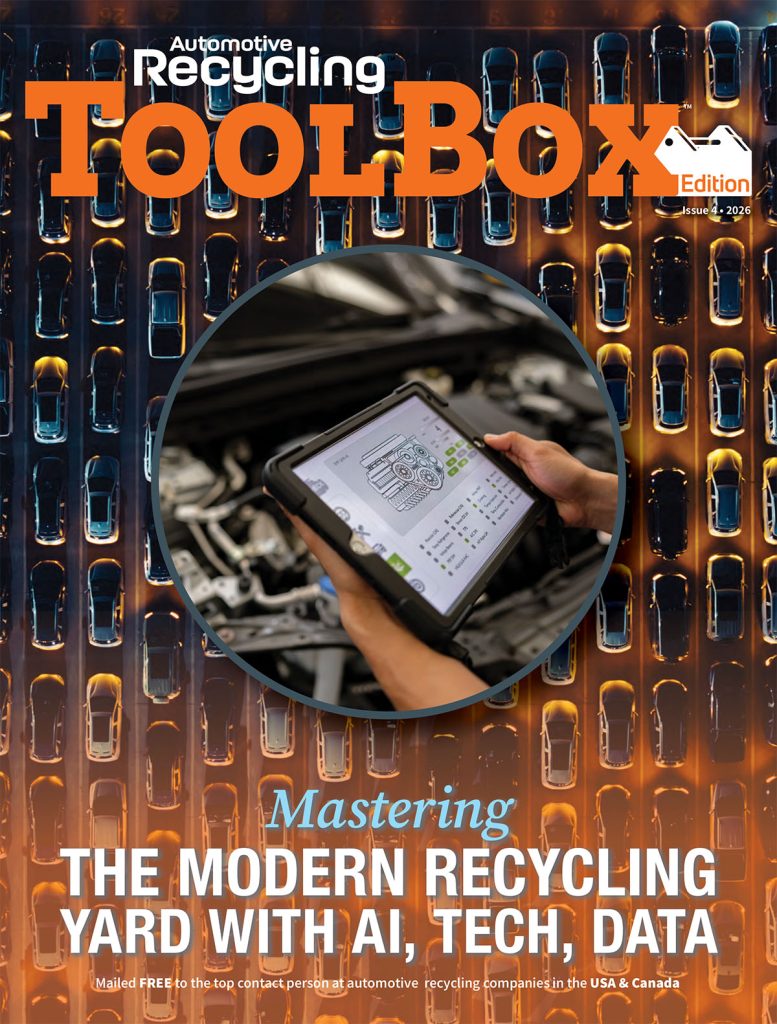
In a high-volume recycling operation, photos are not just marketing assets. They are operational data. Images can confirm condition, color, damage, part type, OEM numbers, trim details, and packaging needs. Computer vision tools can help group images by part, detect defects, standardize backgrounds, identify attributes, and prepare listings with more consistent information.
This matters because marketplace performance depends on accuracy and trust. Buyers want clean images, complete descriptions, correct fitment, fair shipping terms, and confidence that the part will arrive as represented. A listing that is missing a key attribute or uses poor photos may underperform even when the part is in demand.
A proprietary AI-based workflow can help generate stronger titles, item specifics, descriptions, compatibility logic, and pricing recommendations. When connected to marketplace data, it can also learn from search visibility, click-through rates, conversion rates, return reasons, and competitor positioning. Over time, the system can help the recycler understand not only what sold, but why it sold—and why other inventory did not.
That learning should flow back into the yard.
If a certain component repeatedly creates returns because of unclear fitment, that information should improve future listings and buying assumptions. If a certain part type gets many views but few conversions, the issue may be pricing, photos, shipping cost, or compatibility data. If a warehouse location consistently slows fulfillment, the system should surface that friction. If a category has low sales velocity and high storage cost, future dismantling decisions should change.
This feedback loop is where AI becomes more than a tool. It becomes an operating system.
Procurement informs dismantling. Dismantling informs photos. Photos inform listings.
Listings inform sales. Sales and returns inform future purchasing. Warehouse analytics inform what should be stored. Commodity pricing informs what should be separated. Customer-service patterns inform descriptions, packaging, and quality control. Each department still does its own work, but the information no longer stays trapped within it.
For owners and managers, this creates a better way to run the business. Instead of relying only on monthly reports or after-the-fact profitability reviews, a connected system can show leading indicators: vehicles that may not reach break-even, inventory that should be repriced, parts that should be liquidated, categories with rising demand, employees who need training support, and processes that are creating hidden costs.
The future of automotive recycling will still be physical. Vehicles will still be bought, transported, drained, dismantled, photographed, stored, sold, shipped, and processed. The difference is that the best operators will connect those physical steps through data.
AI will not replace the knowledge inside a good yard. It will make that knowledge easier to scale.
The yards that succeed in the next phase may not be the ones that simply process the most vehicles. They may be the ones that know sooner where the value is, which work is worth doing, which inventory deserves space, and how every vehicle can be routed toward its highest and best use.
Automotive recycling has always been about recovery. The next advantage will belong to recyclers who can make recovery predictive.

Vladimir Sainciuc designs proprietary AI operating systems for the U.S. auto dismantling industry, work that helped elevate his family business into the top 1% of the sector across dismantling, processing, and secondary auto-parts resale. His work focuses on VIN-based vehicle analysis, predictive procurement, workflow optimization, computer vision, listing automation, warehouse logic, and the integration of dismantling operations with digital marketplace and material-recovery systems.