How Automotive Recyclers Should Handle a Marketing Flop

By: By Mike French
] Instead of reacting emotionally, they analyze what happened, identify what worked and what needs to change.
Every business owner eventually launches a marketing campaign that doesn’t perform as expected. Maybe you sent postcards to local repair shops and received very few calls. Maybe you ran online ads promoting recycled engines and transmissions, but the response was disappointing. Maybe a promotion you were certain would work simply
fell flat.
When this happens, many business owners react emotionally. Some panic and shut the entire campaign down immediately. Others do the opposite—they keep spending money hoping the campaign will somehow “turn around.” Neither approach is wise.
Smart marketers treat a failed campaign like a diagnostic exercise. Instead of reacting emotionally, they analyze what happened, identify what worked and what needs to change.
In the automotive recycling industry, where margins and marketing budgets must be carefully managed, this disciplined approach can make the difference between wasted money and long-term growth.
Here is a practical process for handling marketing campaigns that don’t deliver the results you expected.
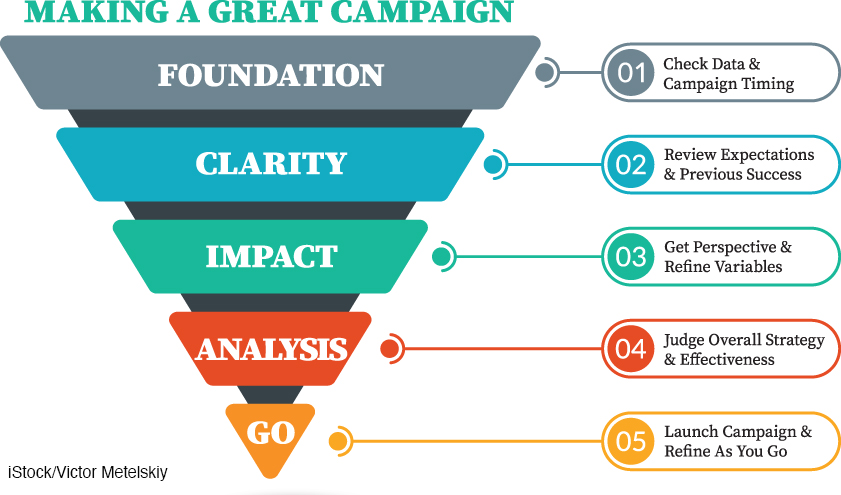
Foundation
Start by Verifying the Facts
Before assuming a campaign failed because of a bad headline or weak offer, check the details. Sometimes the real problem is something much simpler.
For example:
• A mailing list may have been incomplete or outdated.
• Contact information may have been printed incorrectly.
• A call-tracking number may not have been working properly.
• Emails may have landed in spam folders.
• It landed on a weekend or during a storm.
Small operational changes can have a surprisingly large impact. For automotive recyclers, imagine sending a direct-mail campaign to repair shops promoting your inventory of recycled transmissions—but the phone number was printed incorrectly, or the website link was broken. The campaign might appear to have failed when the real issue was simply a technical mistake.
Before rewriting the entire marketing strategy, confirm that the campaign was executed exactly as planned.
Clarity
Check Your Expectations
Sometimes the problem is not the campaign—it is the expectations. If a recycler expects a massive return from a small or poorly targeted campaign, disappointment is almost guaranteed.
Marketing results depend heavily on factors such as:
• The quality of the mailing or contact list
• The strength of the offer
• The competitiveness of the market
• The size of the campaign
For example, sending a few hundred postcards to repair shops may generate a handful of responses—not dozens.
That does not necessarily mean the campaign failed.
It simply means the results should be evaluated realistically.
Successful marketing requires understanding the math behind response rates, conversion rates, and customer value. Without that, business owners may label a campaign as a failure when it is actually performing within normal expectations.
Identify What Actually Worked
Rarely is an entire campaign completely ineffective. Often, some elements work while others do not. Maybe the offer generated interest, but the headline failed to grab attention. Maybe the ad attracted inquiries, but the landing page did not convert visitors into leads. The goal is to identify the pieces that performed well and preserve them.
For example, a recycler running ads for recycled auto parts might discover that:
• Engine and transmission ads generated inquiries
• Body panel ads produced little response
Instead of abandoning the entire campaign, it may make more sense to focus marketing on the high-demand parts categories that are already generating interest. Separating strong from weak elements allows businesses to refine campaigns rather than discard everything.
Impact
Get a Fresh Perspective
One of the biggest obstacles in evaluating marketing is emotional attachment. When business owners create a campaign themselves, they often become personally invested in the idea. That can make it difficult to see flaws objectively. Outside perspectives can be extremely valuable.
Consider asking:
• A marketing consultant
• A trusted industry colleague
• A vendor or advertising partner
A fresh set of eyes may quickly spot problems that were overlooked. Sometimes the issue is obvious to someone who was not involved in the original design.
Focus on Fixing the Right Variables
Once the campaign has been analyzed, improvements should be prioritized. Not all changes have equal impact. For example, adjusting the color of a graphic may have very little effect on response rates. On the other hand, improving the offer or targeting a better customer list can dramatically improve results. Effective marketers focus first on changes that have the greatest potential impact.
Typical high-impact variables include:
• The strength of the offer
• The audience being targeted
• The headline or primary message
• The call to action
Addressing these factors first ensures time and resources are spent where they matter most.
Analysis
Know When to Walk Away
Despite careful analysis and adjustments, some campaigns simply do not work. When that happens, the best decision may be to stop investing in that particular idea and move on.
There is no shame in abandoning a strategy that does not perform. In fact, successful businesses often discontinue weak campaigns quickly so they can redirect their time and budget toward better opportunities. Clinging to a failing campaign because of pride or stubbornness only wastes valuable resources.
Go
Moving Forward
Every marketing professional has experienced both successful campaigns and unsuccessful ones. The difference between struggling businesses and thriving ones is not the absence of mistakes—it is how those mistakes are handled.
Therefore, instead of reacting emotionally, automotive recyclers should approach marketing failures the same way they approach mechanical problems: diagnose the issue, repair what can be fixed, and replace what cannot.
When marketing is treated as a process of testing and improvement, each campaign becomes a learning opportunity that strengthens the next one.

Mike French is retired after 39 years of business in the automotive recycling industry. He is an author, publisher, consultant, and speaker. Mike is the founder and executive director of the Christian Auto Recyclers and Vendors Association (CARVA) and will be at upcoming recycler trade shows and events. Mike is available to speak at your group, conference, or event. He loves to share inspirational stories that demonstrate how the Word of God actively changes lives.
He can be reached at mike@carva.group. Visit www.CARVA.group and/or www.PowerPackedPromises.com.