The 2026 Retention Report is an annual publication by Work Institute which provides a comprehensive overview of trends in employee turnover. Here is an overview excerpt that provides a summary from the report. Find the entire report at https://workinstitute.com/retention-reports/ or call them at 615-777-6400 to connect with them.

About Work Institute
Established in 2000, Work Institute is the leader in employee retention programs, employee engagement strategies and workplace solutions.
We provide employee research, consulting, action planning, development courses, and evaluations of organizations of all sizes including many Fortune 500 clients across multiple industries and geographies.
Our workplace experts help companies reduce employee turnover, boost employee engagement, and develop a thriving workforce using evidence-based actionable insights.
Executive Summary Stability Does Not Equal Confidence
As organizations enter 2026, the labor market appears calmer than it has been in years. Quit rates have declined to pre-pandemic levels. Job openings have moderated. Headlines suggest a return to stability.
Yet beneath the surface, the workforce remains under strain.
Work Institute data reveal a workforce that is staying put but not necessarily staying committed. Employees are delaying exits, not abandoning dissatisfaction. Turnover has slowed faster than confidence has recovered, creating a gap between perceived stability and underlying risk.
This is not a cooling labor market. It is a cautious one.
Employees are weighing uncertainty around career growth, leadership capability, workload, and job security. Economic pressure, shifting industry dynamics, and the rapid adoption of AI have changed how employees evaluate risk. Rather than making immediate moves, many are watching closely and deciding whether their current employer is prepared to support them through what comes next.
These dynamics matters because delayed decisions do not eliminate turnover risk. They concentrate it.
Key Findings from the 2026 Retention Report
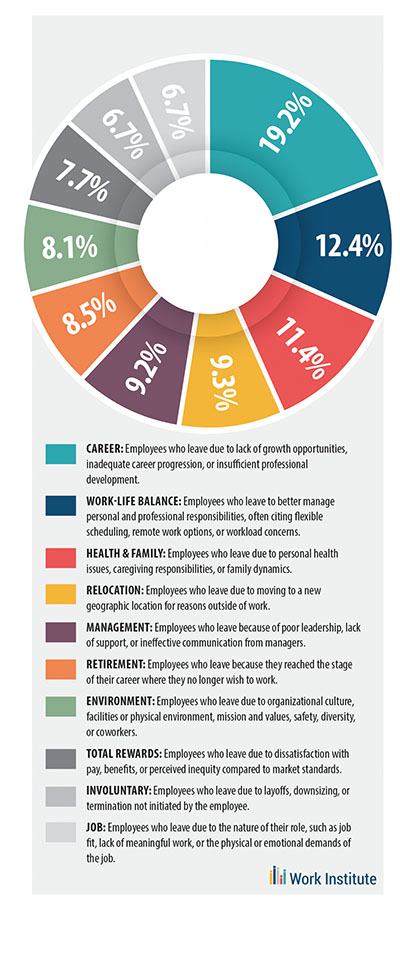
Career remains the primary driver of employee turnover. Career related exits account for nearly one in five departures, continuing a pattern that has persisted for more than a decade. Employees are not just seeking promotions. They are seeking clarity. When development pathways, advancement criteria, and future opportunities are unclear, dissatisfaction builds quietly until employees decide to leave.
Work-Life Balance has become a baseline expectation. Flexibility is no longer viewed as a perk or a pandemic accommodation. Scheduling consistency, workload manageability, commute impact, and hybrid capability are now core components of retention. Organizations that treat Work-Life Balance as optional face growing risk.
Managers remain the most influential point of failure and opportunity.
Manager-related exits remain elevated and highly predictable. While some indicators suggest stabilization, dissatisfaction tied to professional behavior, communication, and expectation setting continue to rise. Employees do not separate their experience with their manager from their perception of the organization.
Job security concerns are reemerging.
Job security has more than doubled as a reason for leaving over the past year. This increase is not driven by widespread job loss, but by anticipatory anxiety tied to AI, automation, and economic uncertainty. Employees are not panicking. They are recalibrating.
Turnover is becoming more expensive, not less. Even as quit rates decline, the financial exposure tied to each exit continues to grow. Higher wages, longer time to productivity, specialized skill requirements, and downstream disruption mean that fewer exits do not necessarily translate into lower cost. In many cases, risk is simply deferred.
What This Means for Leaders
The defining risk of 2026 is not mass resignation. It is quiet disengagement.
Employees are staying longer while reassessing their future. Engagement may appear stable. Headcount may look secure.
But when expectations around growth, leadership, flexibility, and clarity are not addressed, dissatisfaction accumulates beneath the surface.
This creates a fragile workforce. When conditions shift, exits often come faster, in clusters, and at a higher cost.
At the same time, this moment presents a rare opportunity.
Organizations now have something they lacked during the Great Resignation era. They have time.
• Time to strengthen career systems instead of selling career promises.
• Time to equip managers to lead the workforce they have today, not the one they remember.
• Time to address AI related uncertainty with clarity rather than silence.
• Time to close the gap between employee expectations and organizational reality before turnover accelerates again.
Retention has never been about preventing employees from leaving at all costs. It has always been about reducing preventable loss.
The message is clear: turnover is not accidental. It is the result of choices leaders make or avoid.
The organizations that succeed in 2026 will be those that use this period of relative stability to act intentionally, align expectations, and build trust that endures beyond the next shift in the labor market.